
You're likely in the back seat right now, watching Dubai traffic move from a calm residential street to a fast freeway in a matter of minutes, and wondering what the speed limit in Dubai really means for the driver in front of you. The short answer is that it's not one number. It's a road-class system, a radar enforcement system, and a route-planning discipline that matters on every transfer, whether the car is leaving DXB, crossing Sheikh Zayed Road, or easing into DIFC.
For a chauffeur, that difference isn't academic. A car can move from 25 km/h service roads to 120 km/h freeways in one trip, and the driver has to read the road, not just the GPS. Dubai's approach is designed to keep fast traffic flowing while still controlling risk, which is why experienced drivers treat posted signs, lane changes, and buffer zones as part of the job. For passengers, the result should feel calm and smooth, not cautious or confused.
Table of Contents
- Why the Speed Limit in Dubai Matters on Every Chauffeur Trip
- Dubai Speed Limits by Road Type Explained
- The 20 km/h Buffer and Dubai's Graduated Fine System
- Dubai vs Abu Dhabi Speed Enforcement Differences
- How Speed Limits Change Across a Real Dubai Chauffeur Route
- Safe Driving Practices NSB Chauffeurs Follow on Every Trip
- Booking a Chauffeur Who Handles Speed Compliance for You
Why the Speed Limit in Dubai Matters on Every Chauffeur Trip
A black Mercedes easing out of DXB Terminal 3 looks calm from the back seat. Up front, the driver is already reading a changing road pattern, airport access lanes, city streets, and then a faster corridor where lane position and spacing matter just as much as the posted limit. That is why the speed limit in Dubai affects every chauffeur trip, even when the passenger never sees the signs.
Dubai does not work on one citywide pace. It changes by road class, and the driver has to match the road the way a pilot matches each stage of a landing. On parking and service roads, the pace is low. On urban streets, it rises. On freeways, it reaches a different level again, as outlined in the RTA Light Motor Vehicle Handbook. The handbook also explains the light-vehicle framework, including the lower-speed airport and hotel access areas, the urban roads around business districts, and the faster arterial roads that connect them.
Why passengers feel the difference
The same booking can move from a slow hotel driveway in Palm Jumeirah to a fast section of Sheikh Zayed Road, then into a dense district like DIFC or Business Bay. Each shift changes braking distance, arrival timing, and how stable the ride feels from the rear seat. In a chauffeured vehicle, the posted limit is not just a rule for the driver. It shapes the whole experience for the passenger.
A good chauffeur reads those changes early. That means easing off before a tighter road, settling into the correct pace before the car reaches a busier stretch, and keeping the ride controlled instead of reacting at the last second. On Dubai roads, that habit matters because traffic can move from calm to fast very quickly, especially around airport approaches and major business corridors.
Practical rule: on a chauffeured trip, the safest driver is usually the one who adjusts early, not the one who reacts late.
For anyone booking a chauffeur service Dubai trip, that is the value. A professional car with driver Dubai service should make speed control feel natural, so the passenger can work, rest, or look out the window without worrying about cameras, fines, or sudden braking. If you are new to the road signs, this Dubai road signs guide helps connect the posted limit to what you see on the street.
Dubai Speed Limits by Road Type Explained
A chauffeur in Dubai does not read speed limits as one fixed number on a map. The limit changes with the road class, and the job is spotting those changes before the car reaches them. A hotel exit, a city street, and a freeway each call for a different pace, which is why the driving plan has to stay tied to the road itself, as detailed in the RTA Light Motor Vehicle Handbook linked above.
Read the road before the sign catches up
The slowest stretches are the ones that usually demand the most attention. Parking and service roads are posted at 25 km/h, which is the pace you meet around hotel entrances, car parks, and access lanes where pedestrians, luggage, and turning cars all share the same narrow space. Urban single carriageways sit at 40 km/h, and that is the kind of speed that often applies in tighter city districts such as DIFC.
Once the road opens out, the pace changes with it. Urban dual carriageways are posted at 60 km/h to 80 km/h, which is common on wider city corridors, including stretches around Al Wasl Road. Rural roads are set at 100 km/h, and freeways reach 120 km/h for light vehicles. A chauffeur has to read those transitions early, because the car should already be settled into the new pace before the lane pattern changes or traffic starts to compress.
| Road Class | Posted Limit | Typical Dubai Example |
|---|---|---|
| Parking and service roads | 25 km/h | Hotel access lanes, car parks |
| Urban single carriageways | 40 km/h | DIFC streets |
| Urban dual carriageways | 60 km/h to 80 km/h | Al Wasl Road style corridors |
| Rural roads | 100 km/h | Routes heading towards Hatta |
| Freeways | 120 km/h | Sheikh Zayed Road |
What the chauffeur is watching in real time
A passenger usually feels only the overall rhythm of the trip, but the driver is tracking where the road class changes and what that means for spacing, braking, and lane choice. On a premium transfer, the adjustment starts before the signage becomes obvious. The driver eases off in time for a tighter access road, holds a steadier pace through a dense district, and builds a little more space before joining a faster corridor.
That approach matters because the road can shift quickly from calm to fast, especially near airport approaches and major business routes. If the driver waits until the last moment, the ride becomes less settled and the car is more likely to arrive at a camera threshold with no room to correct. A good chauffeur keeps those changes smooth by reading the route ahead, then matching the car to the road instead of forcing the road to match the car.
One useful reminder appears in the Dubai road signs guide for chauffeurs, because the posted limit often makes sense only after you connect it to the signs around you.
The 20 km/h Buffer and Dubai's Graduated Fine System
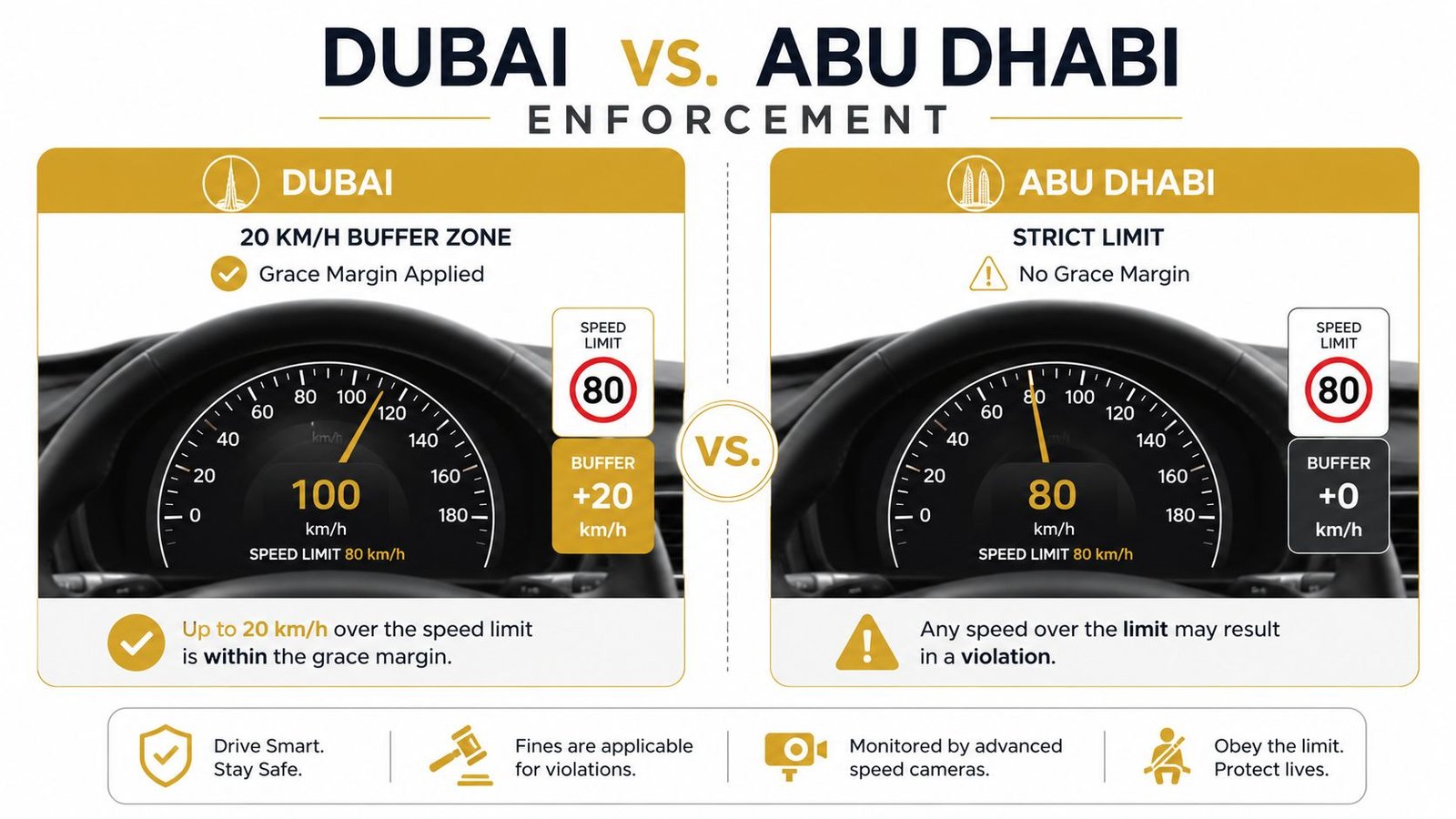
A driver on Sheikh Zayed Road can feel fast and still be within Dubai's enforcement margin, while the same pace near tighter city streets can leave no room for error. That is why the enforcement buffer matters on every chauffeur run. Regional reporting says motorists in Dubai typically face a grace speed limit of about 20 km/h to 30 km/h above the posted limit before radar violations are recorded, although the exact margin can vary by road (Gulf News). It is a tolerance zone for enforcement, not a permission slip to speed.
The fine ladder is one system, not a set of random penalties
Dubai's penalties rise with the amount by which a driver exceeds the limit. The published ladder is Dh300 for exceeding by more than 20 km/h, Dh600 for more than 30 km/h, Dh700 for more than 40 km/h, Dh1,500 for up to 60 km/h over, Dh2,000 for more than 60 km/h over, and Dh3,000 plus 23 black points and a 60-day impoundment for more than 80 km/h over. Those figures are part of the same graduated system, so the jump from a small mistake to a serious penalty can be faster than passengers expect.
For a chauffeur, that structure changes how a freeway stretch is handled. A car running on a 120 km/h section is still being watched against the radar threshold, and a lapse in focus can move the trip from a minor fine to licence trouble. On airport approaches or long business corridors, the safe habit is to stay comfortably below the edge, not to sit on it.
What passengers should understand
Passengers often assume the buffer is a free pass. It is not, and it can vary by road. A good chauffeur reads the posted sign, keeps an eye on the road class, and leaves space inside the safe zone instead of driving right at the margin.
A polished ride should never feel like it is testing the radar.
For anyone choosing a luxury chauffeur service in Dubai, the standard is simple. You want the driver to protect your schedule and your record, not just arrive quickly. If your routes regularly stretch into the capital, a chauffeur service in Abu Dhabi should be set up with the same discipline, because enforcement habits are not identical across the UAE.
Dubai vs Abu Dhabi Speed Enforcement Differences
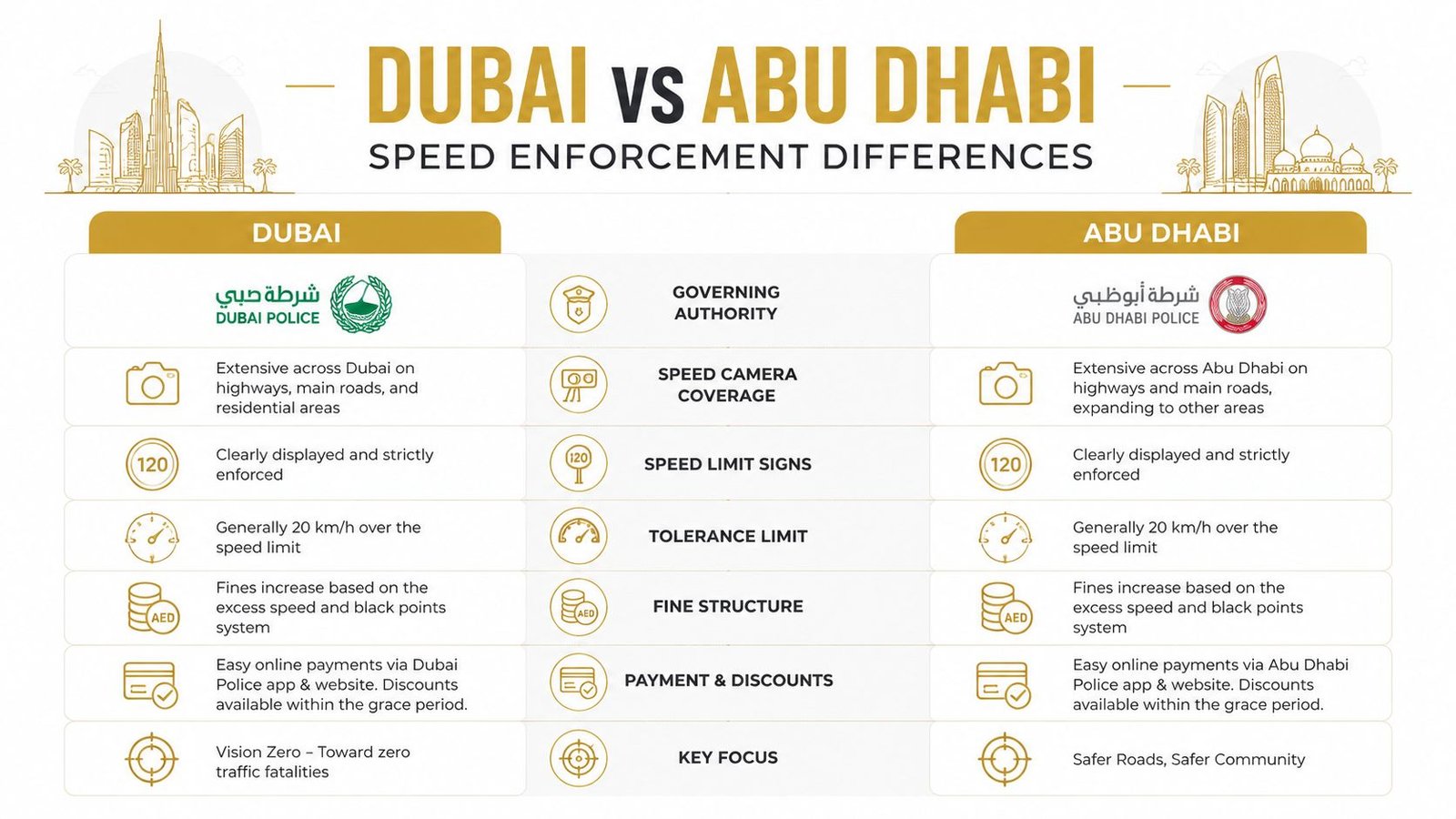
A transfer between Dubai and Abu Dhabi can feel straightforward on the map, yet the speed rule in each emirate can change the driver's margin in a very practical way. Dubai commonly uses a 20 km/h grace margin on many roads, while Abu Dhabi generally does not follow the normal speed-buffer system, so the same posted limit can be treated differently once the car crosses emirate lines (Moov by Al-Futtaim). For business runs, airport transfers, and intercity chauffeur trips, that difference changes how closely a driver can sit to the signposted number.
Why the same road number can mean something else
Abu Dhabi updated several major roads in 2025, including reducing the limit on Sheikh Khalifa bin Zayed International Road (E11) from 160 km/h to 140 km/h, and Abu Dhabi-Sweihan Road (E20) from 120 km/h to 100 km/h, while Dubai continued to use its own signposted limits and a 20 km/h buffer on many roads. That is why a route that feels familiar to a Dubai driver can still demand a different driving rhythm once it enters the capital.
A chauffeur who only remembers the Dubai pattern can misread the road by a small but costly amount. The posted number is only part of the picture, because the enforcement approach is not identical in both emirates, and the safe habit is to reset your expectation at the border instead of carrying the Dubai tolerance straight through the trip.
That matters especially on a chauffeur service in Abu Dhabi booking or a Dubai-to-Abu Dhabi transfer. A driver needs to change pace the same way they would change lanes for a new road class, because the rule set has changed even if the car still feels like it is on one continuous journey.
The practical takeaway for cross-border travellers
A professional chauffeur should check the emirate first, then check the road class, and then drive to the stricter rule that applies on that stretch. That approach keeps the trip calm and predictable, and it avoids the common mistake of treating Dubai's buffer as if it automatically carries into Abu Dhabi.
How Speed Limits Change Across a Real Dubai Chauffeur Route
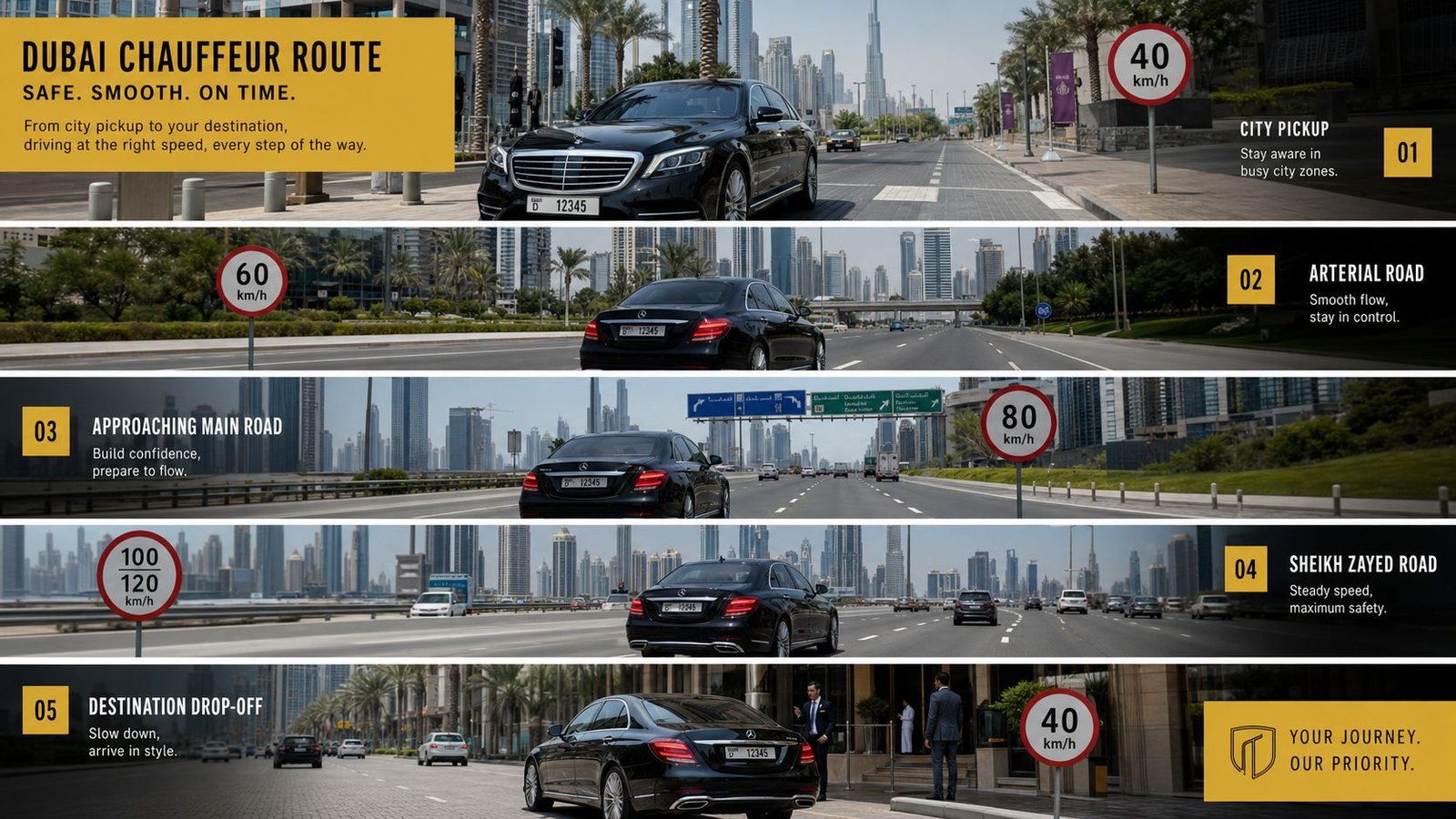
A chauffeur leaving DXB Terminal 3 does not hold one speed for the whole trip. The car may start on slower access roads, join a faster arterial corridor toward Deira, and then settle into the flow of Sheikh Zayed Road. Each change affects merge timing, braking distance, and how calm the ride feels from the back seat.
A route can move through several limits in one booking
A typical airport transfer might begin on 40 km/h access roads or city streets, move into a broader corridor near Al Ittihad Road, then open into a 100 km/h to 120 km/h freeway pattern on parts of Sheikh Zayed Road near Dubai Marina and JBR, before slowing again into Business Bay and then DIFC. Those stretches do not all feel the same from the driver's seat. One moment the car is threading through tight city movement, the next it is gliding on a faster highway segment, then it is back into a district where turns, signals, and lane discipline matter more than speed.
That is why local knowledge matters around landmarks like Downtown Dubai, Palm Jumeirah, and Bluewaters Island. A driver who knows the city will not accelerate just because the road looks open, and will not brake late just because the next exit seems close. The road class sets the pace, and the posted limit tells the chauffeur how much room there is to work with.
For routes that pass through freeway corridors with toll gates, the planning also has to account for Salik in Dubai. Toll points often sit on the same high-flow segments where the car is switching between faster and slower driving patterns, so the chauffeur has to read the route as one connected sequence instead of a list of separate streets.
The practical value shows up in timing. If the vehicle leaves a hotel in Dubai Marina and heads to a meeting in DIFC, the driver may pass through freeway stretches, city traffic, and business district slow zones in one trip. A chauffeur who understands those transitions gives the passenger a steadier arrival, fewer jolts, and less wasted time at lane changes.
Driver's habit: watch the next road class, not the one you're currently on.
Safe Driving Practices NSB Chauffeurs Follow on Every Trip
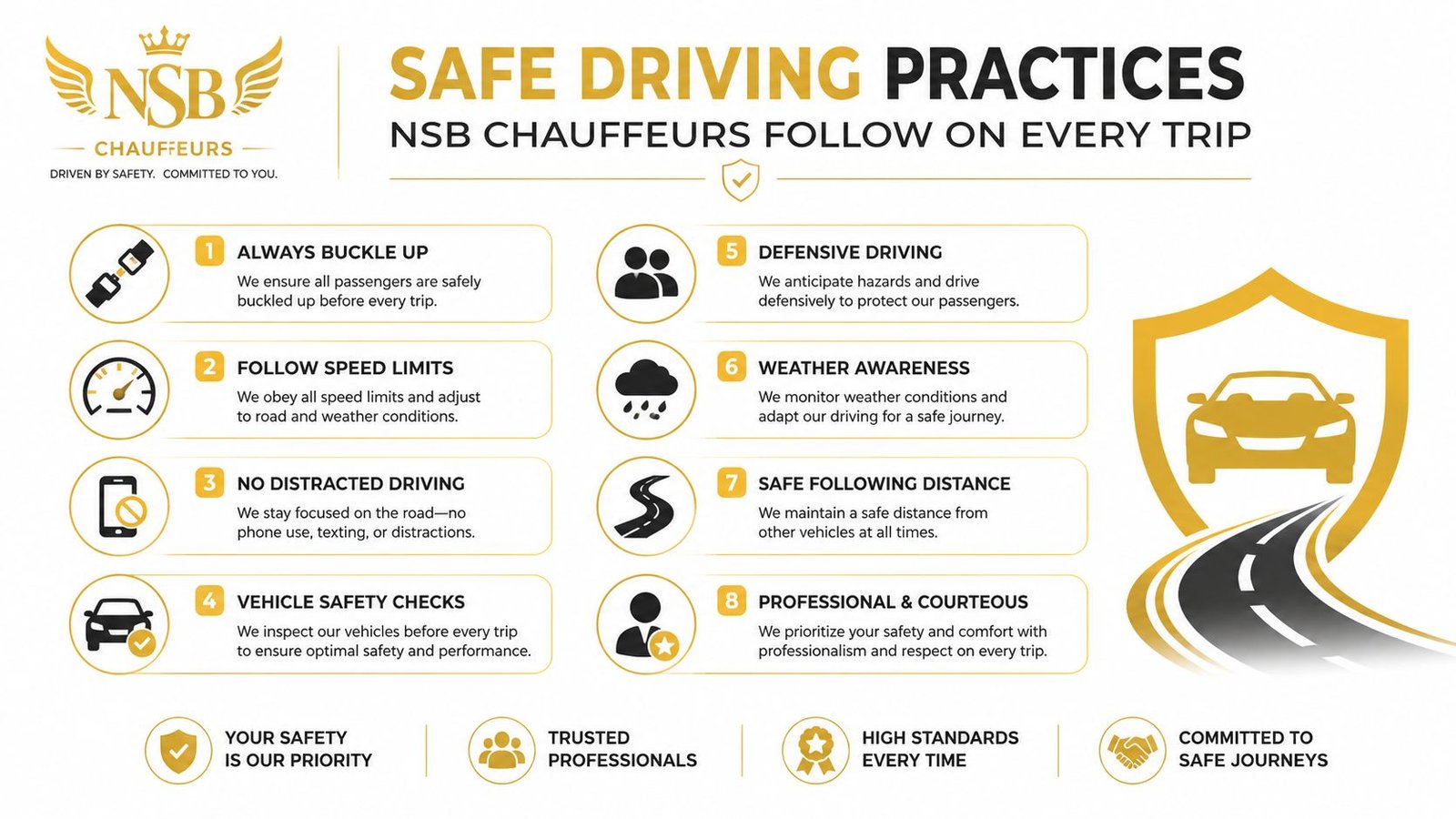
Professional driving in Dubai is mostly about anticipation. The chauffeur studies the route before departure, checks the posted limits on navigation and road signs, and adjusts driving style to the road class instead of trying to keep one constant pace. That approach makes the cabin feel calm, which is what executive passengers, families, and VIP guests usually want most.
What careful chauffeurs do differently
A good chauffeur checks the route against the UAE's road-speed framework, where parking areas and service roads sit at 25 km/h, urban single carriageways at 40 km/h, urban dual carriageways at 60 km/h or 80 km/h, rural roads at 100 km/h, and highways at 100 km/h to 140 km/h for light vehicles (Gulf News). That's why route-specific planning matters more than a single citywide number.
A careful chauffeur also softens acceleration after merges, keeps the car centred and predictable in faster corridors, and stays alert near school and work zones where traffic behaviour changes quickly. These habits don't just reduce fine risk. They make the ride feel composed, which is what passengers notice in a premium vehicle.
Why this matters for executives and family travel
For executives, a disciplined driver protects arrival times and keeps the focus on meetings, not road stress. For families, it reduces the sudden braking and lane-swapping that can make children or older passengers uncomfortable. That's also why many travellers prefer a chauffeur in Dubai over self-driving when the day includes multiple stops.
The best chauffeur behaviour is almost invisible. The car feels smooth, the route feels planned, and the passenger never has to wonder whether the driver is guessing at the limit.
Booking a Chauffeur Who Handles Speed Compliance for You
A booking decision becomes clearer once you understand the speed limit in Dubai. You are choosing a driver who knows how to move between road classes, respect buffer zones, and avoid the black-points ladder that can punish careless driving. That matters on airport transfers Dubai trips, full day car with driver Dubai bookings, and longer routes into Muscat, Riyadh, or Dammam.
A premium vehicle also changes the experience in practical ways. Luxury chauffeur services in Dubai commonly use executive sedans and larger options such as the Mercedes S-Class, BMW 7 Series, GMC Yukon XL, and Mercedes V-Class, which give you a quieter cabin and more room for luggage or colleagues. The point is not just appearance. It is reliable scheduling, discreet service, and a driver who already knows how the roads behave.
For travellers comparing options, a professional chauffeur service has one advantage that app-based rides cannot always match, route discipline. The driver is trained to work with Dubai's posted signs, the enforcement buffer, and the emirate-specific rules that affect intercity travel. That makes a premium booking feel safe rather than merely convenient.
A useful starting point is the homepage. From there, travellers can review Airport Transfers Dubai, Full Day Car with Driver Dubai, Dubai to Muscat Private Car, and Dubai to Riyadh Chauffeur Service. Each route uses a different booking pattern, but the same driving discipline applies, posted limit first, smooth pace through the buffer, and constant attention to changing road signs.
Book Your Chauffeur Service
Fast booking support for airport transfers, chauffeur service, and private car with driver in Dubai.
WhatsApp: +971 525 579 638
Email: booking@nsbluxurytransport.com
Website: www.nsbluxurytransport.com