
Salik is Dubai’s automated road toll system that uses RFID technology to charge vehicles passing through specific toll gates. You don’t need to stop. The fee is deducted automatically from a prepaid account linked to a tag on the vehicle’s windscreen.
If you’re arriving in Dubai for meetings in Business Bay, a stay on Palm Jumeirah, or a direct transfer from DXB Airport, Salik is one of those local systems you’ll encounter quickly without always noticing it. The roads remain fast-moving because there are no cash booths and no barrier arms. Cars pass under the gantry and continue.
For residents, that usually means managing a tag and prepaid balance. For tourists, short-stay visitors, and business executives, the confusion usually starts with practical questions. Will you be charged directly? What happens in a rental car? Are tolls added later? Could there be fines if a vehicle isn’t properly registered? Those are the details that matter when you want a smooth itinerary and no surprises after the journey.
This guide answers what is Salik in Dubai, where the toll gates are, how the charging system works, when tolls apply, and what non-residents should pay special attention to. If you’re weighing private transport against app-based rides, this comparison of VIP chauffeur service vs ride-hailing in Dubai is also useful for understanding the difference in predictability and travel comfort.
Travel Across Dubai Without Worrying About Salik Charges
Let NSB Luxury Transport handle the roads, Salik tolls, parking, and navigation while you enjoy a smooth luxury ride. Book premium chauffeur service for airport transfers, business travel, city tours, or full-day hire in Dubai.
Call / WhatsApp: +971 52 557 9638
Email: booking@nsbluxurytransport.com
Table of Contents
- Your Essential Guide to Salik in Dubai
- What Is Salik and How Does the System Work
- Where Are the Salik Toll Gates Located in Dubai
- Understanding Salik Fees Timings and Payments
- How Salik Works for Tourists Renters and Chauffeur Clients
- The Benefits of Navigating Dubai with a Professional Chauffeur
- Frequently Asked Questions About Salik in Dubai
- Do tourists need to buy their own Salik tag
- What happens if a vehicle crosses a Salik gate without a registered tag
- Is Salik active on every road in Dubai
- Are there times when Salik is free
- Can I avoid Salik completely
- Do Salik charges matter for airport transfers
- Is Salik difficult to understand once you know the basics
Your Essential Guide to Salik in Dubai
When people ask what is Salik in Dubai, the simplest answer is that it’s the city’s electronic toll system for selected major roads. It forms part of Dubai’s transport infrastructure and is designed to keep vehicles moving through busy corridors rather than stopping them at toll booths.
That matters most on routes visitors use often. Think of transfers between Deira and newer parts of the city, travel along Sheikh Zayed Road, or journeys near airport approaches and business districts. Salik works in the background, but it affects route planning, travel time expectations, and trip costs.
Why visitors often find it unclear
Residents usually learn the system once and then forget about it. Visitors don’t have that luxury. They may be using a rental vehicle for only a few days, taking taxis between hotels and event venues, or relying on a private driver for a tightly scheduled itinerary across Downtown Dubai, Dubai Marina, JBR, Jumeirah, or Business Bay.
Practical rule: You don’t need to fear Salik. You just need to know who is managing it for your journey.
What you need to understand first
A few basics remove most of the uncertainty:
- It’s automated: there’s no booth, ticket, or cash handover.
- It applies only at specific gates: not every road in Dubai has a toll.
- Responsibility depends on how you travel: rental company, taxi operator, or transport provider.
Once those three points are clear, the rest becomes straightforward.
What Is Salik and How Does the System Work
You land at Dubai International, your meeting in DIFC starts in an hour, and the car glides onto a main highway with no toll booth in sight. A few minutes later, a charge has still been recorded. That is Salik.
Salik is Dubai’s electronic road toll system. Instead of stopping vehicles at a barrier, the system identifies the car as it passes under a toll gate and logs the crossing automatically. For visitors, the easiest way to understand it is this: the road keeps moving, but the toll still applies.
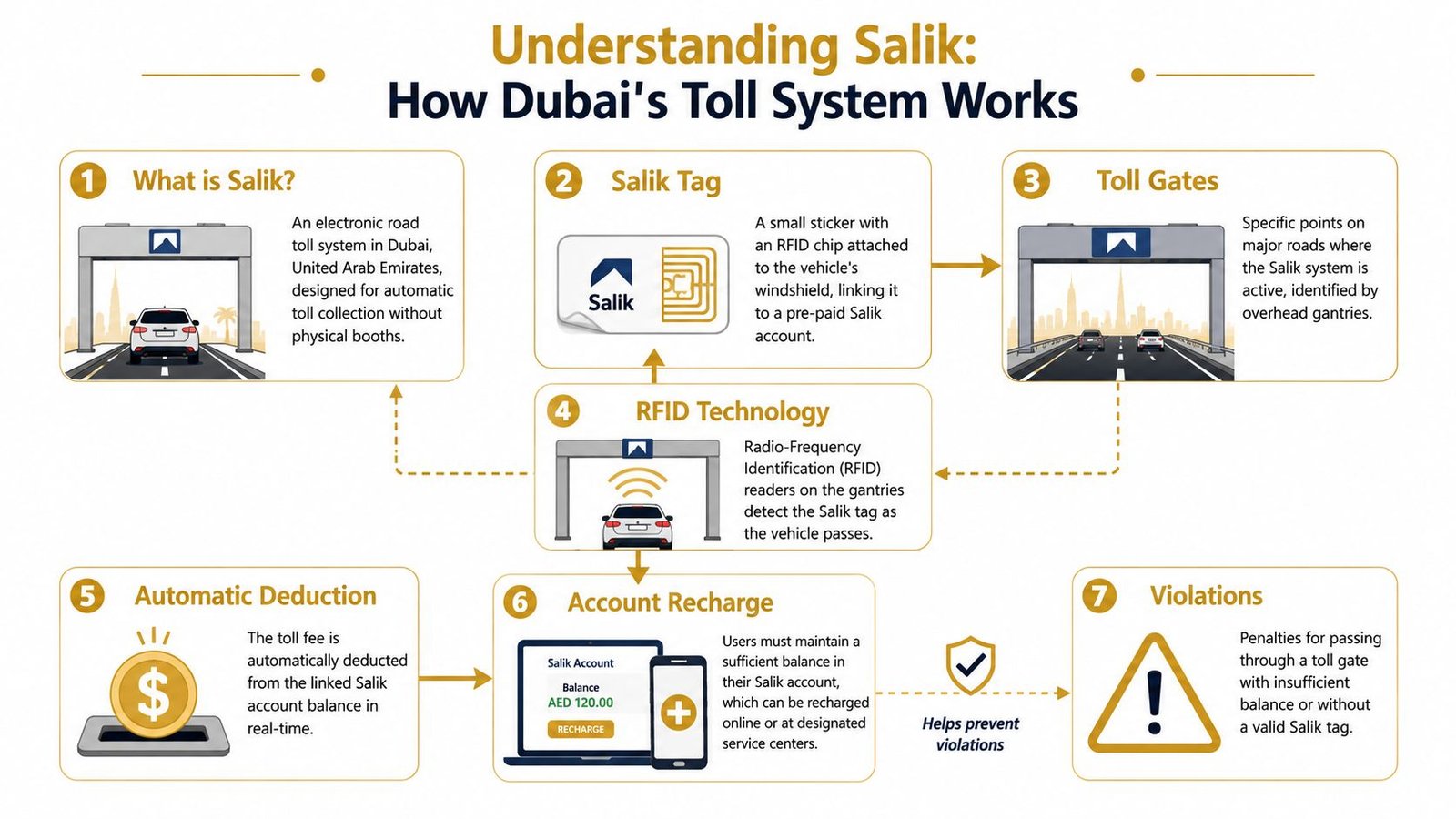
Salik works like a contactless payment system linked to the vehicle rather than the driver. In a privately managed car, a tag is fixed to the windscreen and linked to an account. As the vehicle passes beneath a gate, the system reads the vehicle details and registers the toll in the background.
How a Salik crossing is recorded
The process is straightforward:
- A Salik tag is installed on the vehicle windscreen.
- The vehicle passes under a toll gate on a Salik road.
- The system identifies the vehicle electronically.
- The toll is posted to the linked account or operator system.
There is no cash payment at the gate, no paper ticket, and no need for the driver to slow down for a manual check. That matters on busy routes used by airport transfers, executive meetings, hotel pickups, and full-day city itineraries.
For non-residents, the main point is responsibility. The toll is attached to the vehicle journey, but the party managing the vehicle usually handles the charge. In a rental, that is often the rental company. In a taxi, it is built into the operator’s process. In a chauffeured booking, the transport provider generally manages it on your behalf, which is one reason many visitors prefer a pre-arranged service when comparing overall Dubai airport transfer costs and inclusions.
For chauffeur clients, this removes a common source of confusion. You are not expected to search for a toll booth, buy a road pass mid-journey, or guess whether a crossing was missed. The charge is tracked through the vehicle system, and any billing responsibility should be clear in your booking terms.
A good rule for luxury travellers and business executives is simple. If someone else is operating the vehicle, confirm before the trip whether Salik is included in the fare, billed separately, or absorbed by the provider. That one question prevents billing surprises and keeps your itinerary running without friction.
Where Are the Salik Toll Gates Located in Dubai
Your chauffeur leaves DIFC for a marina-side meeting, takes the fastest corridor, and reaches on time. Later, you review the booking and see a toll line you did not notice during the ride. That is usually how Salik enters the conversation for visitors. In the background, on the roads that connect the places you are most likely to use.
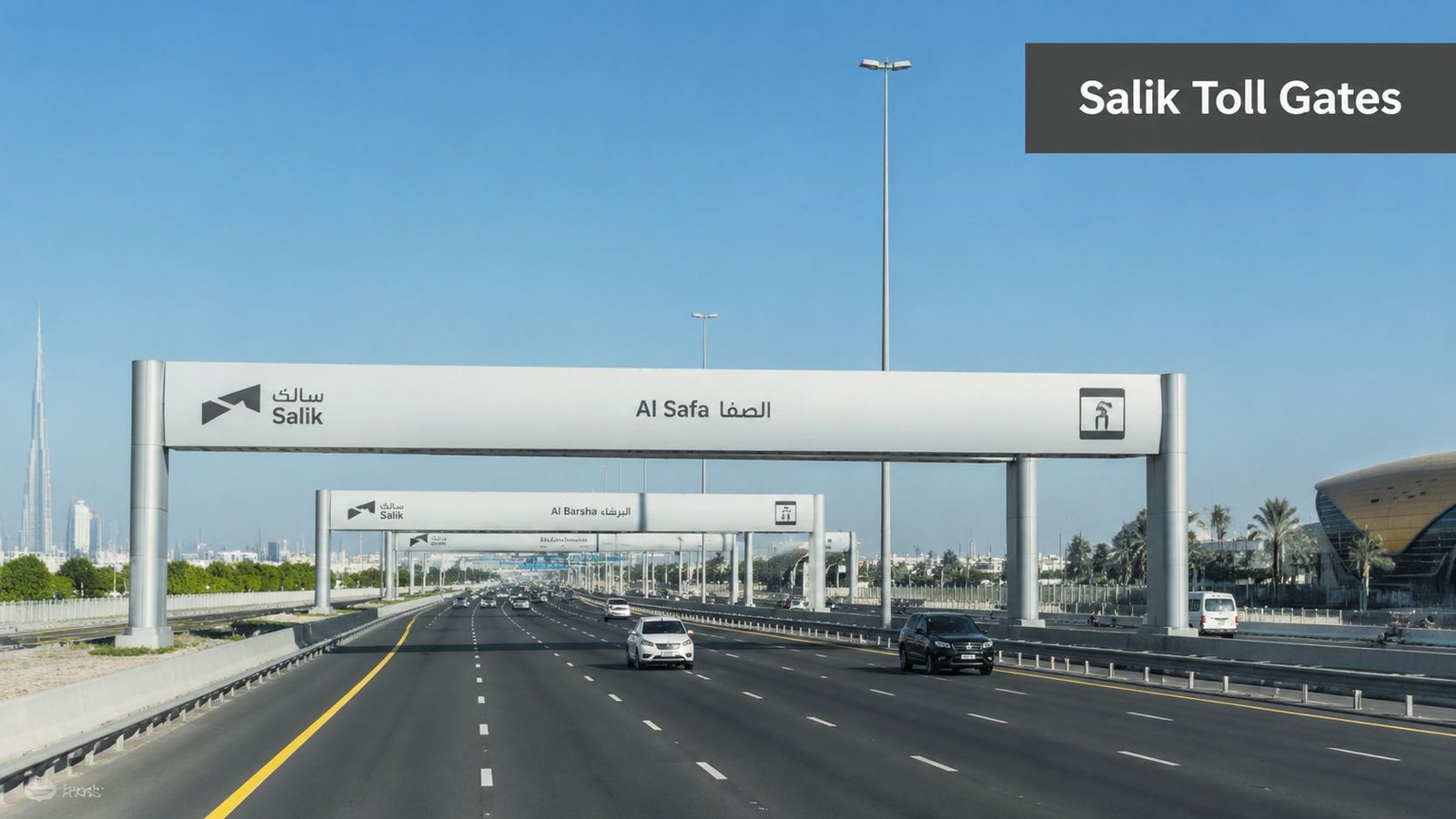
As noted earlier, Dubai has ten Salik toll gates. For a visitor, the practical question is not memorising all ten. It is knowing which parts of the city commonly involve toll crossings, especially if your itinerary includes the airport, Downtown, Dubai Marina, Palm Jumeirah, Business Bay, or older districts around Deira and Dubai Creek.
Gates visitors are most likely to encounter
These are the locations that tend to matter most on tourist, executive, and hotel transfer routes:
- Al Barsha: often appears on Sheikh Zayed Road journeys serving Dubai Marina, JBR, and routes toward Palm Jumeirah.
- Al Garhoud Bridge: relevant for trips involving older Dubai districts and some airport-side movements.
- Business Bay Crossing: commonly affects travel around Downtown Dubai, DIFC, and Business Bay.
- Airport Tunnel: one of the key points to know for journeys linked to DXB and nearby corridors.
- Jebel Ali: more likely on longer Sheikh Zayed Road runs toward Dubai’s southern districts.
A simple way to read this is by corridor, not by gate name. Sheikh Zayed Road routes often pick up Salik on business and leisure trips across newer Dubai. Airport and creek-side routes can do the same on transfers between DXB, Deira, Bur Dubai, and central hotel areas.
For chauffeur clients, this matters because route choice and billing responsibility are separate questions. The driver or operator chooses the road based on traffic, timing, and the service plan. Your concern is whether tolls are already included or added to the final bill. That point should be clear before the journey, especially for airport arrivals, executive roadshows, and same-day multi-stop schedules.
If your transfer starts or ends at DXB, this guide to Dubai airport drop-off planning and route considerations helps explain how busy airport corridors are usually handled.
A good chauffeur service makes this feel routine. You should not need to track gantries during the ride or work out later why a direct route cost more than a slower one. For non-resident travellers, that clarity is often the difference between a pleasant transfer and an avoidable billing dispute.
Understanding Salik Fees Timings and Payments
A guest lands at DXB for a two-day board meeting, reaches the hotel without stopping once, and later asks a sensible question: where did the road tolls go, and who paid them? Salik often feels invisible during the journey because there are no toll booths or cash points at the gate itself. The charge is recorded in the background and settled through the vehicle’s registered setup.
That distinction matters more for non-residents than for Dubai drivers who already manage their own account. If you are visiting for business, arriving with family, or using a chauffeur service, the practical question is not the engineering behind Salik. It is how the toll appears in the final transport cost and whether that responsibility sits with you, the rental company, or the transport provider.
Salik Toll Fee Structure 2026
| Time of Day | Day of Week | Toll Fee (AED) |
|---|---|---|
| 1:00 AM to 6:00 AM | Daily | 0 AED |
| 6:00 AM to 10:00 AM | Weekdays | 6 AED |
| 4:00 PM to 8:00 PM | Weekdays | 6 AED |
| Other non-night hours | As applicable outside the peak windows above | Fees vary by time period |
| Any time | Sunday | 0 AED |
A simple way to read this table is by travel pattern. Early-morning airport runs before 6:00 AM do not attract a Salik fee. Weekday trips during the morning and late-afternoon rush usually cost more. Sunday is treated differently, which can help if you are planning leisure outings or a lighter business schedule over the weekend.
For residents, payment is tied to the car's Salik registration and balance. They are responsible for keeping the account active and funded.
For visitors, the process depends on the type of vehicle you are using:
- Rental cars: the rental company usually records each crossing and adds the charge later under its billing terms.
- Taxis: the toll is generally folded into the fare calculation, so the passenger experiences it as part of the trip total.
- Pre-arranged chauffeur services: toll handling depends on the provider's pricing model, so the right question to ask is whether Salik is included or billed separately.
For chauffeur clients, this should be clear before the first pickup. A well-run executive transport service will define whether tolls are bundled into the quoted rate, itemised afterward, or covered within a minimum-hour booking structure. That clarity matters on airport transfers, full-day disposals, and meeting schedules that cross the city several times.
If you are estimating total transport spend rather than only the vehicle rate, this guide to airport transfer costs in Dubai gives helpful context on what may be included in a private transfer quote beyond the base ride itself.
How Salik Works for Tourists Renters and Chauffeur Clients
This is the part many non-residents need. The issue usually isn't what is Salik in Dubai. It's who pays, when the charge appears, and what happens if the vehicle isn't properly set up.
For visitors, passing through Salik without a registered tag creates real risk. There is a 10-working-day grace period, after which fines can escalate with each crossing, as noted in this background on Salik compliance for visitors.
If you're using a rental car
A rental vehicle usually already has the required setup in place, and the company records toll use during the hire period. The detail travellers often overlook is timing. The charge may not feel visible at the gate itself, so it can show up later in the final bill or post-rental reconciliation.
That's where confusion begins. A guest may think a route was straightforward, only to find additional toll-related charges after return because the costs were tracked in the background.
If you're taking a taxi
Taxi travel is usually simpler from the passenger's perspective because the toll is commonly folded into the trip calculation. You're less likely to worry about tags or account balances, but you still don't control route choice in the same way you might with pre-arranged executive transport.
For short city hops, that may be perfectly fine. For a day built around meetings, hotel pickups, event arrivals, or family schedules, many travellers prefer more certainty.
If your travel is chauffeur-managed
For executives, VIP guests, and visitors with a fixed schedule, the main advantage of a professional service is that vehicle compliance is handled for you. You aren't trying to interpret grace periods, check whether a rental tag is active, or wonder who receives any toll-related notice tied to the vehicle.
The smoothest Salik experience for a visitor is the one they never have to think about.
That's particularly useful when your day includes airport arrival, hotel transfer, business appointments in Business Bay, dinner in Downtown Dubai, and a late return to Dubai Marina or Palm Jumeirah. In those cases, the transport question isn't just about the car. It's about removing small operational risks that can become administrative annoyances later.
If you need a vehicle and driver for several meetings or a full day of city movement, this option for full-day car rental with driver in Dubai shows the type of travel setup many visitors prefer over self-drive arrangements.
The Benefits of Navigating Dubai with a Professional Chauffeur
A professional chauffeur service makes Dubai travel easier in the ways visitors notice most. You have one confirmed vehicle, one clear schedule, and one point of responsibility for the journey, whether the day involves an airport arrival, a hotel departure in DIFC, meetings in Business Bay, or dinner at the Palm.
That matters even more for non-residents. If you are visiting for a board meeting, a short luxury stay, or a family holiday, you usually do not want to spend time figuring out road layouts, hotel access points, valet procedures, or whether a toll charge will appear later with little context. With chauffeur-managed transport, those details are handled as part of the service.
Why this matters for business and VIP travel
For executives, transport should support the schedule, not compete with it. A good chauffeur keeps the day orderly, allows for quiet calls between appointments, and reduces the chance of small disruptions such as a missed pickup point or confusion at a busy entrance.
For leisure travellers and families, the value is different but just as practical. After a long flight, most guests prefer an easy transfer to the hotel, help with luggage, and direct movement between planned stops without having to compare app options on the spot.
Key advantages often include:
- Consistent timing: pickups planned around flights, meetings, reservations, and event access windows.
- Better local judgment: drivers who know the common business, hotel, and leisure corridors across the city.
- Comfort and discretion: useful for rest, private conversations, and high-profile travel.
- Clearer charge handling: Salik and other vehicle-side logistics are usually managed within the service framework, which reduces uncertainty for visitors.
Why chauffeur service often suits non-residents better
Dubai roads are straightforward once you know them, but first-time visitors can find the city spread out in unexpected ways. A route that looks simple on a map may involve complex interchanges, timed pickups, tower access rules, or busy drop-off zones.
A chauffeur addresses that gap in local familiarity. It works much like having an experienced host who already knows which entrance your hotel prefers, how long airport collection may take at a given terminal, and which route best fits the timing of your day.
That is especially helpful with Salik. Many general guides explain what the toll system is, but they do not clearly address who deals with it when the passenger is a tourist or executive guest using a chauffeured vehicle. In that arrangement, the transport provider generally manages the operational side, so the passenger is not left wondering about tags, gate crossings, or follow-up notices connected to the car.
For a closer look at what premium ground transport typically includes, this guide to luxury chauffeur service in Dubai explains the service structure in more detail.
Frequently Asked Questions About Salik in Dubai
Do tourists need to buy their own Salik tag
Usually, no. If you're using a taxi, rental car, or pre-arranged transport, the vehicle side is typically managed by the operator or provider. The important point is understanding how toll charges are passed on to you, if they are.
What happens if a vehicle crosses a Salik gate without a registered tag
There is a 10-working-day grace period. After that, fines can escalate with further crossings. For visitors, that's why vehicle compliance matters more than many travel guides make clear.
Is Salik active on every road in Dubai
No. Salik applies only at designated toll gates on key roads and corridors. Many city movements don't involve a toll gate at all, while others naturally do because the fastest route passes through one.
Are there times when Salik is free
Yes. Salik is toll-free between 1:00 AM and 6:00 AM daily, and it is also free on Sundays. That can be useful for planning certain leisure journeys or lower-pressure travel windows.
Can I avoid Salik completely
Sometimes, but not always without trade-offs. Alternative routes may exist, yet they can add time, complexity, or less convenient road access depending on where you're travelling between.
Do Salik charges matter for airport transfers
They can, especially on routes touching major corridors and airport approaches. For passengers, the practical concern is whether the transfer pricing is transparent and whether toll handling is already accounted for in the transport arrangement.
Is Salik difficult to understand once you know the basics
Not at all. Most confusion comes from the payment responsibility, not the system itself. Once you know that the toll is automatic and tied to the vehicle setup, the process becomes much easier to follow.
Book your ride with NSB Luxury Transport, available 24/7 across Dubai and the UAE. Whether you need airport transfers, chauffeur services, corporate transportation, full-day car hire, or cross-border travel to Oman and Saudi Arabia, our professional chauffeurs and luxury fleet are ready to assist. Book online at nsbluxurytransport.com or contact us via WhatsApp.
In practical terms, what is Salik in Dubai? It's a fully automated toll system that keeps traffic moving on major Dubai roads while charging vehicles electronically in the background. For residents, that means managing a tag and prepaid account. For visitors, the key concern is knowing who is handling the toll, the route, and any compliance risk.
If you're travelling for business, arriving with family, or coordinating a VIP itinerary, clarity matters. Smooth transport in Dubai comes from removing uncertainty before the journey starts. When your airport transfers, city movements, and executive travel are professionally arranged, Salik becomes one less detail to think about.
Book Your Chauffeur Service
Fast booking support for airport transfers, chauffeur service, and private car with driver in Dubai.
WhatsApp: +971 525 579 638
Email: booking@nsbluxurytransport.com
Website: www.nsbluxurytransport.com