
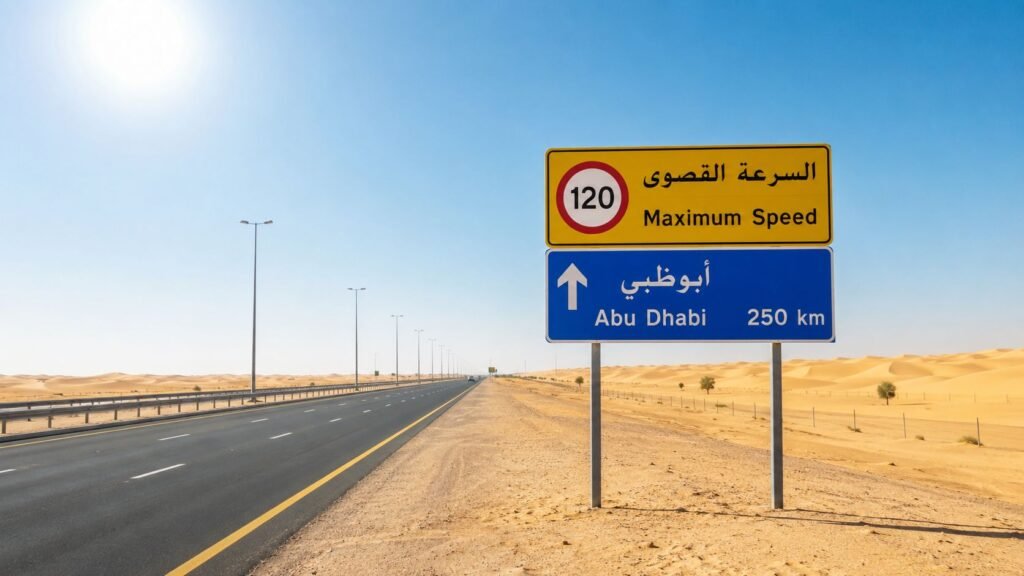
Learn the meaning of essential UAE road signs with this complete 2026 driving guide. Understand traffic symbols, speed limits, warning signs, and road regulations for safer travel across the United Arab Emirates
You’re likely in the back seat right now, checking the route on your phone and wondering how the road signs in Dubai and Abu Dhabi work. UAE road signs are designed to be clear, but the mix of bilingual text, symbols, lane markings, and time-based restrictions can still feel overwhelming if you’re new to the country. For a VIP client, a business traveller, or a family arriving for the first time, the difference between a smooth transfer and an unnecessary delay often comes down to reading the signs early and correctly.
That’s why this guide focuses on practical interpretation, not just memorising shapes. You’ll see how the system works, which signs matter most in real driving, and how signs affect decisions at airport exits, downtown parking areas, toll roads, and major highway junctions. If you’re travelling with a chauffeur, this knowledge also helps you understand why the route changes, where delays come from, and how a professional driver keeps the journey calm and controlled.
Table of Contents
- Understanding the Language of UAE Road Signs
- Key Categories of Road Signs in the UAE Explained
- Essential UAE Road Signs Every Visitor Must Know
- Speed Limits and Penalties What You Need to Know
- Navigating Special Zones Tourist Areas and Toll Roads
- Your Printable UAE Road Signs Cheat-Sheet
- Why a Professional Chauffeur Offers Complete Peace of Mind
Understanding the Language of UAE Road Signs
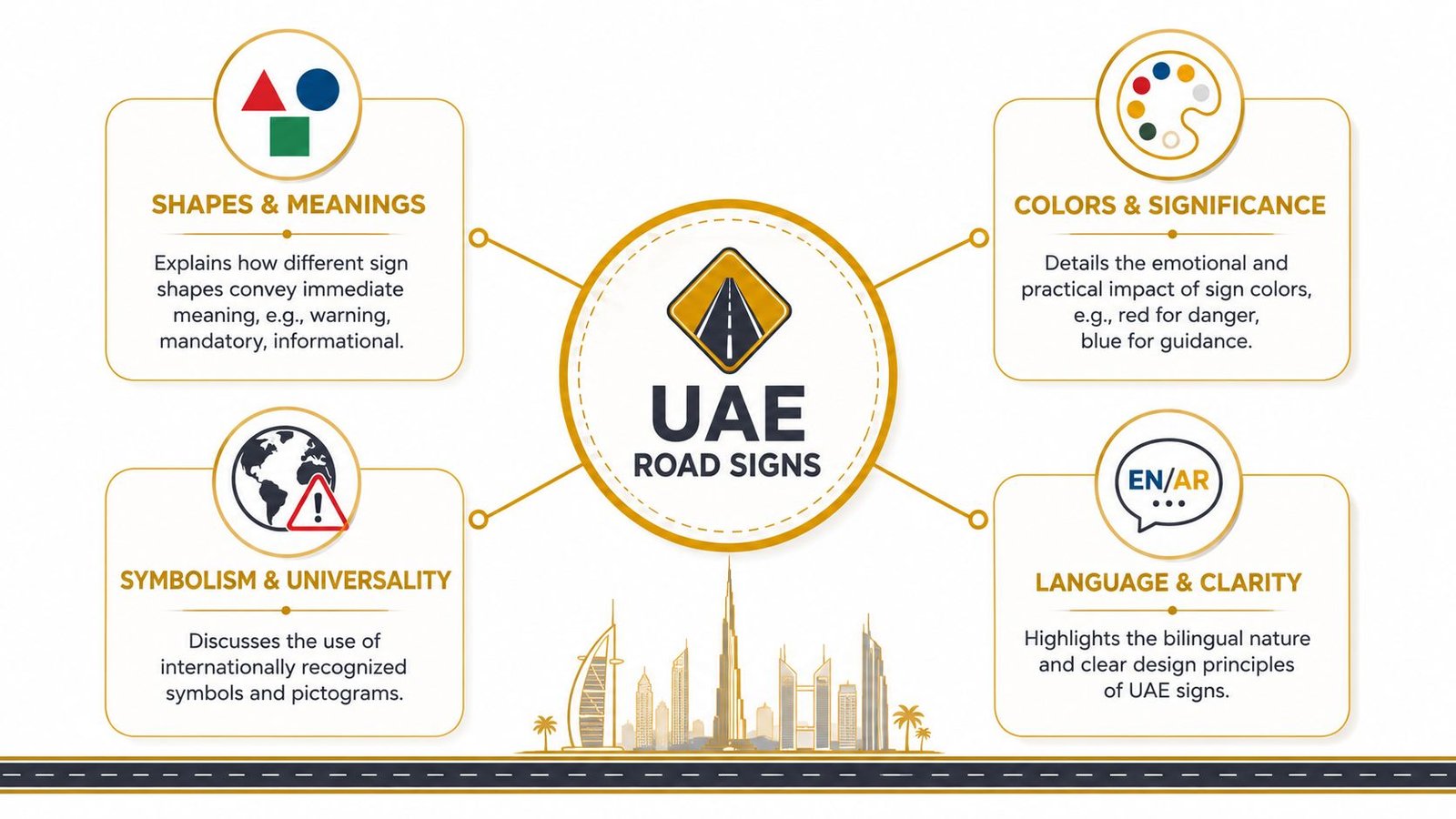
The easiest way to read UAE road signs is to treat them like a language with grammar, not a list of random symbols. The system uses English and Arabic together, plus internationally recognisable symbols, so drivers from many backgrounds can understand the message quickly as described in the UAE traffic-sign overview. That matters in a country where local, regional, and international drivers share the same roads every day.
Shapes give you the first clue
Before you read the words, look at the shape. Circles tell you a sign is regulatory, triangles with red borders warn you about danger, and rectangles usually guide or inform you as outlined in the UAE road-sign guide. The design is practical because it lets you classify the sign’s purpose at a glance, which is helpful when traffic is moving quickly.
Practical rule: if you can identify the shape early, you’ve already reduced the chance of a last-second mistake.
Colour helps you read the road faster
Colour works the same way. In the UAE, red is used for prohibitory or mandatory control, blue for guide signs, and green for parking control signs according to the standard traffic-sign overview. That colour logic saves time when you’re scanning a busy junction, especially if you’re unfamiliar with the area or relying on live navigation.
One useful detail for visitors is that route numbering is also standardised. Emirates routes appear as rectangular green signs with white numbers, which makes it easier to stay oriented between emirates and major corridors as noted in the UAE road-sign reference. If you’re connecting from Dubai to Abu Dhabi, that structure is part of what keeps intercity travel readable.
The official English signal chart for Dubai also shows how much the system depends on symbols instead of text alone, which helps non-Arabic speakers read the road more confidently Dubai signal chart. For a visitor, that means the fastest reading strategy is simple, shape first, colour second, text last.
A small practical example
If you see a red-bordered triangle, slow down before you fully read it. If you see a circle, expect a rule you must follow. If you see a rectangle, treat it as guidance that helps you choose the correct lane, exit, or destination.
For airport arrivals and city transfers, this is especially useful because road signs in the UAE are often layered, not isolated. The same approach helps you understand route guidance around terminals, hotels, and major districts, including complex arrivals around Dubai’s airport network linked here for reference.
Key Categories of Road Signs in the UAE Explained
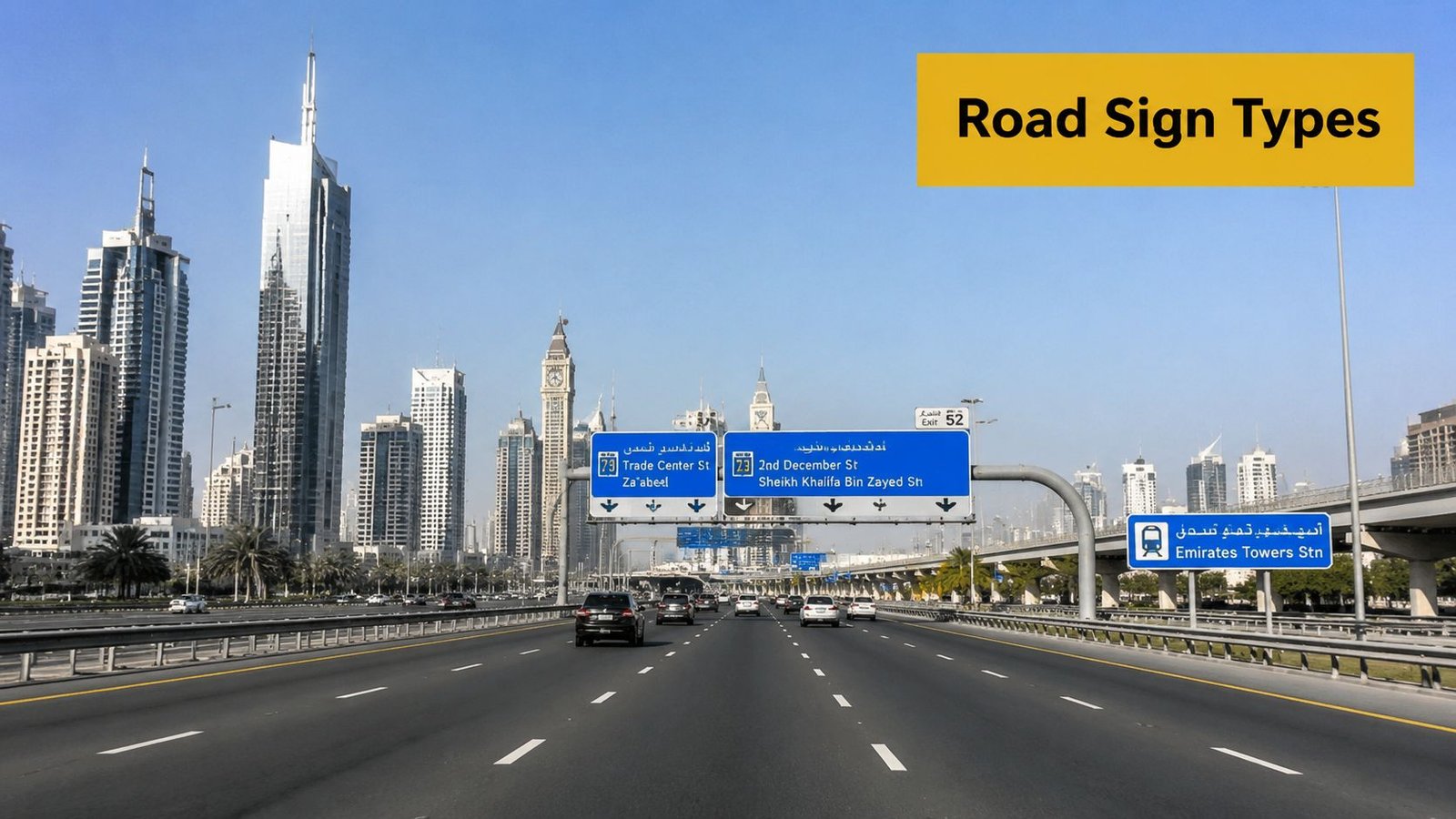
Once you know the shape-and-colour logic, the next step is grouping signs by function. That makes the system much easier to remember because every sign is asking you to do one of three things: obey, watch out, or receive guidance. This is clearly reflected in the UAE’s design, where circles indicate regulatory actions, triangles with red borders provide warnings, and rectangles convey informational or directional details as explained in the road-sign guide.
Mandatory and regulatory signs
Regulatory signs are the ones you must follow. They control behaviour such as entry, turning, stopping, and other enforceable actions. Because they are circular, they stand out visually and reduce the mental effort needed to decide whether the instruction is optional.
For a chauffeur, this matters at junctions where lane choice changes quickly. A circular sign tells the driver there’s a firm rule in force, not just a suggestion. In practice, that removes ambiguity in dense traffic around central business districts and busy arterial roads.
Warning signs
Warning signs alert you to something ahead that needs caution. The red-bordered triangle is the key visual cue as described in the guide. You’ll see this style before sharp bends, merging lanes, pedestrian activity, or other hazards that require earlier braking or lane discipline.
A warning sign is useful before the hazard becomes visible. By the time you see the actual problem, you may already be too close.
Informational and guide signs
Rectangular signs are the road’s direction system. They point to exits, destinations, lane assignments, and services. In Dubai and Abu Dhabi, these are often the signs you rely on most when moving between districts, highways, and landmark areas.
For VIP travellers, guide signs are especially important because the road network can change from open highway to tight urban exit in seconds. The earlier you identify the lane instructions, the easier it is to stay calm and avoid last-minute weaving. That’s one reason the shape convention is so valuable, it lets the driver understand the sign before reading every word.
Essential UAE Road Signs Every Visitor Must Know
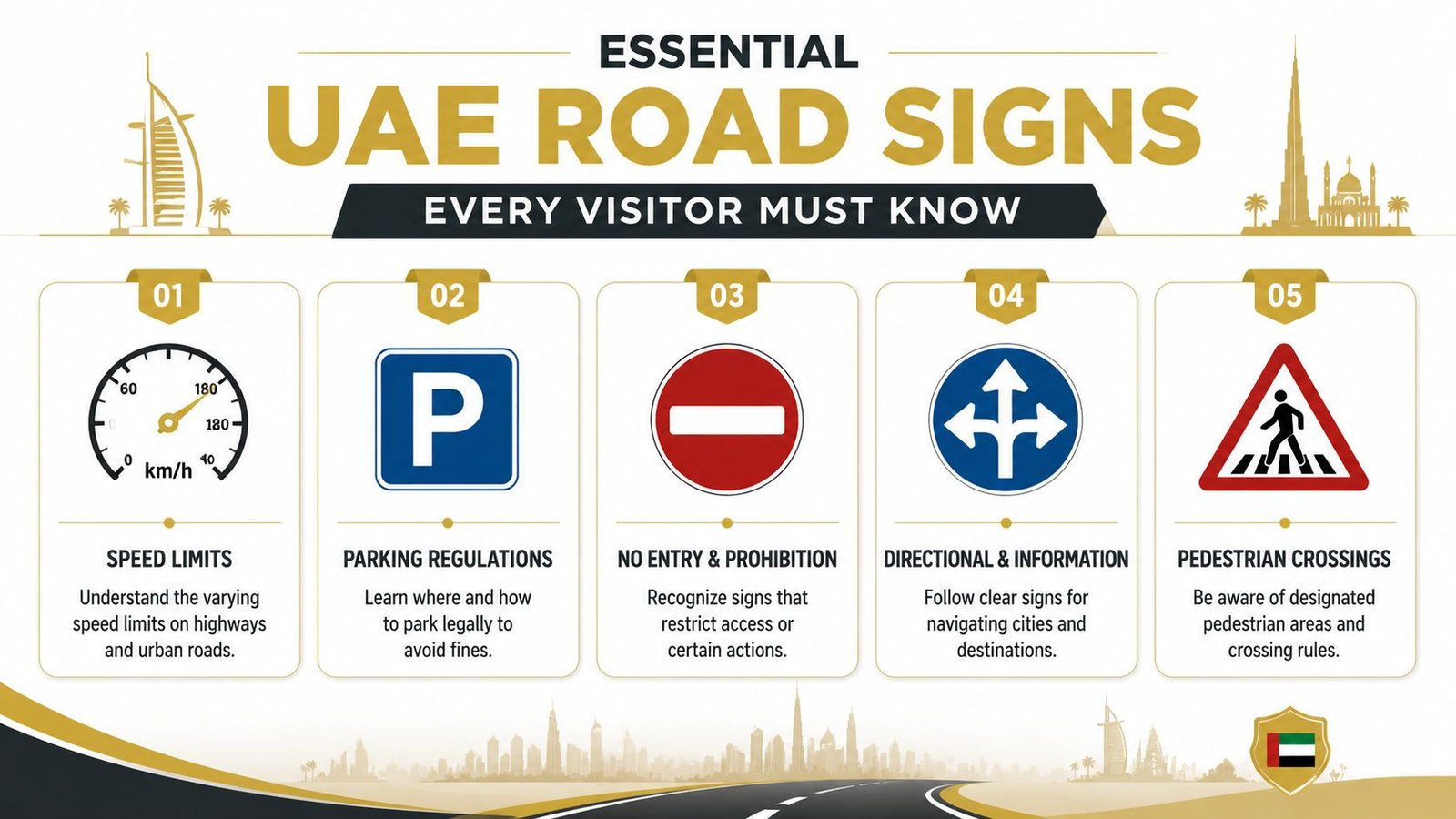
A visitor usually doesn’t need to memorise every sign. You need the ones that affect daily movement, parking, tolls, and the most common mistakes. That’s where the practical value is, because a single overlooked sign can disrupt a hotel arrival, a meeting schedule, or an evening booking in a busy district.
Signs you’ll meet almost immediately
Speed limit signs are among the first signs most travellers notice, especially when leaving the airport or entering a highway corridor. Parking signs matter just as much, because the UAE has clear rules around authorised and unauthorised spaces. Parking in permit-only areas without authorisation can result in an AED 1,000 fine plus 4 black points as noted in the traffic-sign guidance.
Directional signs also deserve attention. They guide you through exits, lanes, and city movements, which is important when your route passes through places like Downtown Dubai, Business Bay, or the road network near a hotel district.
What a visitor should read first
- Speed limits: Check these before you trust the flow of traffic around you.
- Parking rules: Read every panel before leaving the vehicle, especially in commercial and mixed-use areas.
- No entry and prohibition signs: Treat these as hard stops, not suggestions.
- Directional panels: Follow lane arrows early so you’re not forced into a late merge.
- Pedestrian crossings: Expect slower movement near retail, residential, and school zones.
Blue Salik signs are another familiar marker in Dubai, while brown signs often point to tourist zones as identified in the guidance. For travellers, that means the colour of the sign often gives away the type of road or destination before the text is fully read.
If you want a deeper chauffeur-focused comparison of route handling and comfort, the service overview linked here shows why informed driving matters in premium transport.
Speed Limits and Penalties What You Need to Know
Speed is where sign awareness becomes financial. The UAE uses clear signposting, but the consequences of missing a restriction can be expensive and disruptive. A 2025 UAE traffic-sign guide reports fines of AED 500–1,000 depending on the emirate plus black points for certain violations, which is why reading signs is a legal issue as much as a driving habit source.
Why penalties matter in day-to-day driving
Visitors often assume the surrounding traffic is the best guide. It isn’t. The posted sign is the instruction that counts, especially in areas where the road layout changes quickly. That matters on urban streets, approach roads, and service lanes where the limit can differ from the main carriageway.
For clients who value time and predictability, missed signage is more than a fine. It can trigger stress, delay a meeting arrival, and complicate vehicle handover or parking. A careful driver reads the road early and treats every sign as part of the route plan.
| Common UAE Traffic Violations and Penalties | ||
|---|---|---|
| Violation | Fine (AED) | Black Points |
| Speeding or other sign-based violations | 500 to 1,000 depending on the emirate source | Applies to certain violations source |
| Parking in a permit-only area without authorisation | 1,000 source | 4 source |
Reading speed signs the smart way
A clean habit helps here. Scan for the posted limit before looking at the traffic around you. Then check again when the road opens up, because signs can change as you move from an access road to a highway or from an urban corridor into a controlled zone.
The safest assumption is simple, the sign is the rule, even if surrounding drivers look comfortable moving faster.
If you're comparing premium transport options and want a driver who already knows the local sign logic, the service page here is a practical reference point.
Navigating Special Zones Tourist Areas and Toll Roads
Tourist and toll-road signs are where many visitors become uncertain, because these roads combine navigation, access control, and time-based rules. In Abu Dhabi, the Darb toll system charges AED 4 per vehicle during peak periods from 7:00 am to 9:00 am and 3:00 pm to 7:00 pm from Saturday to Thursday, with no fee on Fridays and official holidays official UAE guidance. That schedule makes signage important, because drivers need to know not just where they are going, but when a toll applies.
What to look for on special routes
Blue Salik signs in Dubai indicate toll roads, while brown signs often point to tourist zones as noted in the traffic-sign guidance. That distinction helps you decide whether you're entering a charged corridor or heading toward a visitor area, a heritage destination, or a landmark district.
For a guest moving between a hotel, a business meeting, and an evening reservation, the main value is clarity. The driver can plan the route around toll gates, while the passenger stays focused on the schedule instead of the road system.
Why these signs matter in practice
Toll and tourist signs are rarely standalone instructions. They sit inside a larger route flow, which means the driver has to read them in sequence with lane arrows and overhead guidance. That's why these signs are more useful when understood as part of the whole route, not as isolated symbols.
If you're using a chauffeur, this is one of the biggest comfort advantages. The route decision is already made, the toll logic is handled, and the passenger doesn't need to worry about missing a sign at speed. For Dubai travellers, the related Salik explanation here gives extra context on how toll roads fit into everyday driving.
Your Printable UAE Road Signs Cheat-Sheet
A one-page cheat-sheet is useful because road-sign recognition fades fast when you're under pressure, tired after a flight, or trying to find a hotel entrance in traffic. A quick reference keeps the important signs in front of you when you need them most. If you'd like a practical version to keep on your phone or print for the car, the download linked from this travel resource is designed for exactly that purpose.
A good cheat-sheet should do four things well:
- Quick reference: Give you an at-a-glance summary of the most useful sign meanings.
- Key signs included: Focus on the signs visitors meet most often.
- Print and go: Fit easily into a glove box, folder, or mobile gallery.
- Simple recall: Help you remember what matters before you reach the junction.
For visitors who don't drive in the UAE every day, that small bit of preparation can remove a lot of uncertainty. It's especially helpful for rental car users, first-time business travellers, and families moving between districts, hotels, and attractions.
Why a Professional Chauffeur Offers Complete Peace of Mind
Once you understand UAE road signs, it becomes clear why local driving experience matters so much. A professional chauffeur reads the road early, knows how to handle lane discipline, toll corridors, parking restrictions, and the timing of signs around major destinations. That means the passenger doesn't have to interpret every junction while managing meetings, luggage, or family travel.
Where the value shows up
- No sign stress: The driver handles the decisions, so you don't have to second-guess the route.
- Cleaner arrivals: Parking rules and access signs are managed before they become a problem.
- Smoother timing: Toll roads and roadwork diversions are factored into the journey.
- Better focus: You can work, rest, or speak privately during the drive.
This matters most in busy areas where signs change quickly, such as airport approaches, central business districts, and hotel-heavy corridors. It also matters on longer inter-emirate journeys, where road markings and guide signs become part of the travel rhythm. For a client who wants a controlled, discreet journey, that local knowledge is the difference between travel and transport.
If you want a calm, reliable way to move around Dubai and the UAE without reading signs yourself, book your ride with NSB Luxury Transport. Available 24/7 across Dubai and the UAE, whether you need airport transfers, chauffeur services, corporate transportation, full-day car hire, or cross-border travel to Oman and Saudi Arabia, our professional chauffeurs and luxury fleet are ready to assist. Book online at NSB Luxury Transport or contact us via WhatsApp.
UAE road signs are much easier to understand once you read them as a system of shapes, colours, and actions. That knowledge helps you move through Dubai and Abu Dhabi with more confidence, fewer surprises, and a better sense of what the road is asking you to do. If you're travelling for business, family, or a special occasion, the safest option is still the simplest one, let an experienced chauffeur handle the signs while you focus on the day ahead.
Book Your Chauffeur Service
Fast booking support for airport transfers, chauffeur service, and private car with driver in Dubai.
WhatsApp: +971 525 579 638
Email: booking@nsbluxurytransport.com
Website: www.nsbluxurytransport.com