
You've just pulled up to a Dubai toll gate and checked your Salik balance a second too late. That's the moment where Salik pay online stops being a convenience and becomes a damage-control task. The right channel matters, because the wrong workflow wastes time, delays posting, and can leave you with a fine when you thought you'd already topped up. Salik's own 2024 sustainability report says more than 95% of its revenue is generated online, so this isn't a side process, it's the system itself, with tolls charged when a vehicle passes a gate and penalties applied when the account balance is low or the vehicle isn't registered official Salik sustainability report.
If you handle Dubai roads for work, treat this as operational basics, not admin. The reader's job is simple, recharge the tag, pay a fine, or check the balance, and each one has its own correct channel. Get that separation right and you avoid gate-side panic, unnecessary support calls, and last-minute detours to sort out a payment you should have completed online.
Table of Contents
- Why Salik Pay Online Matters for Dubai Drivers
- Official Channels for Salik Online Payments
- How to Recharge Salik Through the Salik Website and App
- How to Top Up Salik Using DubaiNow and the RTA Dubai App
- How to Check Salik Balance and Pay Salik Fines Online
- When Paying Salik Online Costs More Than Rerouting
- Troubleshooting Common Salik Online Payment Issues
Why Salik Pay Online Matters for Dubai Drivers
A low-balance Salik account usually fails at the worst moment, on the way to DXB Airport, a client meeting in DIFC, or a transfer across Business Bay. Executive fleet teams feel it first because one missed recharge can affect a vehicle that should already be cleared for the next run. The fix is straightforward: treat recharge, fine payment, and balance checks as separate workflows. Use the right channel for the right task, or you waste time and invite enforcement costs.
That separation matters even more for drivers who move between Dubai and Abu Dhabi on tight schedules, including those using Abu Dhabi chauffeur services. A car that reaches a gate with insufficient funds does not care whether the trip is a school run, a board meeting, or an airport pickup. The account has to be ready before the gate, not after it.
Salik's official reporting shows how tightly online toll settlement sits inside daily mobility in Dubai. In Q1 2026, Salik reported 197.2 million total trips, 145.7 million chargeable trips, AED 728.9 million in revenue, AED 507.2 million in EBITDA, and AED 369.3 million in net profit Gulf News coverage of Salik Q1 2026 results. Those figures are useful because they show how much routine travel depends on online toll settlement working without delay.
Practical rule: if you are not sure whether you owe a recharge or a fine, check the account status first. Guessing costs more than a minute of verification.
For executive fleets, that discipline is basic. A vehicle that passes a gate with insufficient funds creates the same problem whether it is on a school run, a board meeting, or an airport pickup. Keep the account ready before the gate.
Official Channels for Salik Online Payments
Organize Salik channels by task rather than by app name. That keeps the decision clean. Use one route for recharge, another for fines, and a third for balance checks. A lot of confusion starts when drivers open the wrong portal and expect every Salik action to sit in one place.
Use the Salik website when you want the most direct account-based workflow. Use the Smart Salik app when you want the same core service on mobile. Use DubaiNow or the RTA Dubai app when you already handle government or vehicle services there. Dubai Drive suits drivers who keep several transport tasks in one place, and bank or telecom payment portals can work for routine top-ups, depending on the portal setup. For chauffeur teams that also manage airport movements, including those using Abu Dhabi airport transfer services, the value is speed, not variety. Pick the channel that gets the job done without a second attempt.
| Channel | Best For | Login Required |
|---|---|---|
| Salik website | Recharge, fines, account management | Yes |
| Smart Salik app | Recharge and balance checks | Yes |
| DubaiNow | Utility-style top-ups and linked services | Usually yes |
| RTA Dubai app | Vehicle and fleet-related tasks | Yes |
| Dubai Drive | Driver-facing top-ups and account access | Usually yes |
| Bank or telecom portals | Simple recharge workflows | Varies |
The escalation lines are worth saving before a failed transaction forces you to look them up. Inside the UAE, the hotline is 800-SALIK (72545), and the international line is +971 4 2335000.
Decision rule: if the task is a fine, start with the Salik account or a fines-capable app. If the task is a recharge, use the account top-up flow. Do not mix them.
For travellers and transfer operators, that split saves time and prevents the wrong menu search when a client is already in the car. It also keeps dispatch from wasting minutes on a recharge screen when the problem is an unpaid violation.
How to Recharge Salik Through the Salik Website and App
A Salik recharge should be boring. That is the goal. Use the Salik website or the Smart Salik app, log in, choose Recharge, select your payment method, and confirm the amount. The official guidance says the balance usually updates instantly or within seconds after payment confirmation, which is what matters when a vehicle is due back on the road RTA Smart Salik app guidance.
The payment rails are straightforward. Visa, Mastercard, Apple Pay, and Samsung Pay are the common options. The minimum top-up is where operators need to slow down. One route shows an AED 50 minimum top-up, while some plate-based, no-login portals show AED 100 minimums, so confirm the amount inside the exact channel before you pay. If you are deciding whether to recharge a Dubai-bound car now or route it differently first, the Abu Dhabi to Dubai route guide helps you weigh the trip against the toll exposure.
The part drivers should never skip
Check the plate number and tag ID before you confirm payment. A wrong plate entry is the usual reason people think the top-up failed. It often succeeded, just on the wrong vehicle record.
Keep the process tight. Enter the account, choose the top-up amount, select the payment rail, and hold on to the receipt until the balance appears in the account.
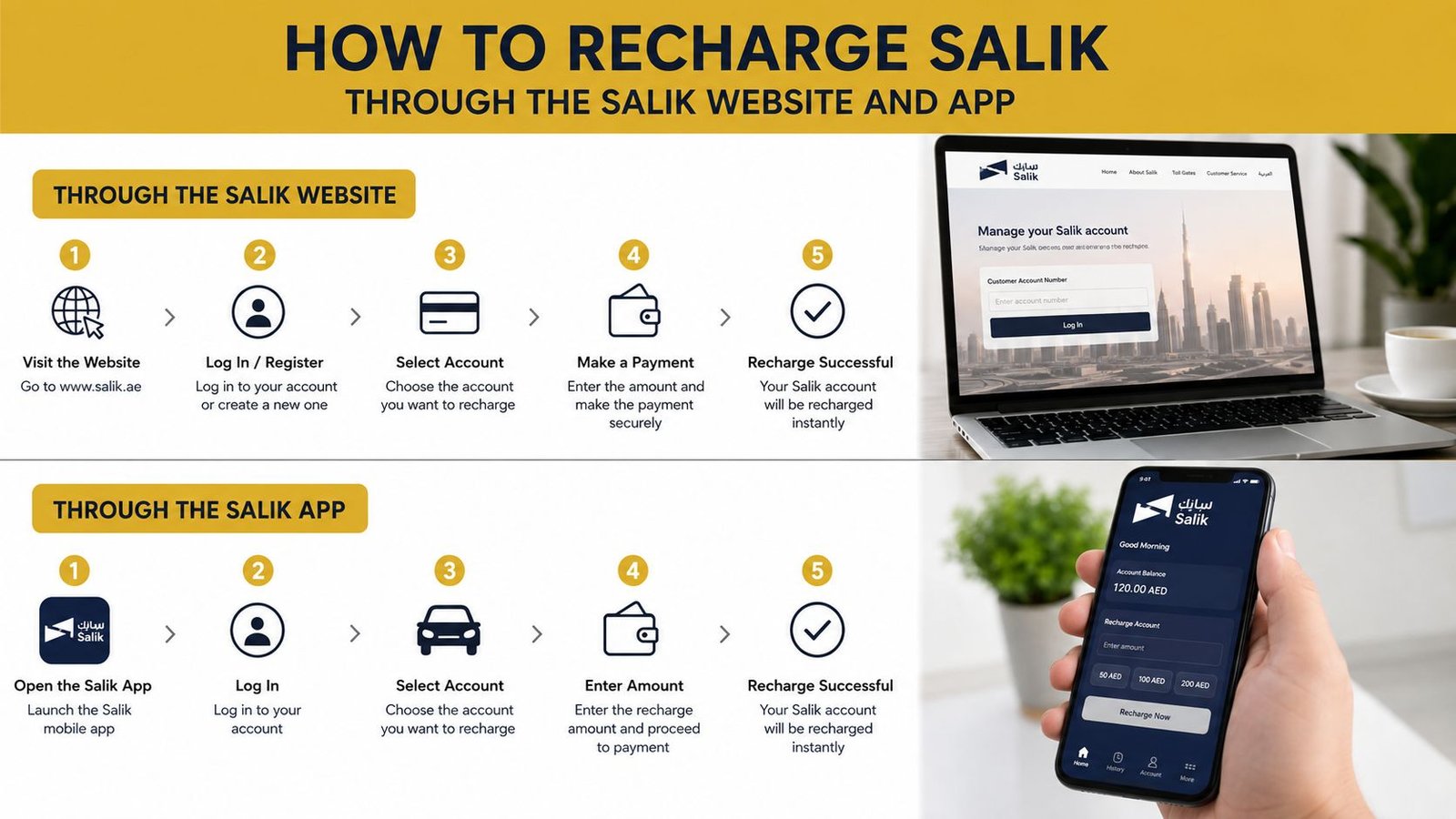
For an executive fleet, check the vehicle record before you touch the card details. That habit takes seconds and saves a support call later.
How to Top Up Salik Using DubaiNow and the RTA Dubai App
DubaiNow and the RTA Dubai app make sense for people who already live inside those ecosystems. They're not identical to the Salik app, and that difference matters. DubaiNow is the more general government-services route, while the RTA Dubai app is the better fit for users who manage vehicles, permits, and transport-related tasks in one place.
In DubaiNow, the practical move is to log in with UAE Pass, find the Salik service tile, and choose the recharge or linked payment path from there. The app is useful for users who prefer a broader government-services environment instead of a standalone toll app. The RTA Dubai app serves fleet-minded drivers well because it already sits beside other transport tasks, which means less app-switching when a vehicle needs immediate attention.
Which app fits which habit
If you're handling a few personal vehicles, DubaiNow can be enough. If you're handling an executive fleet or a corporate travel desk, the RTA Dubai app is the more disciplined choice because it keeps transport-related management closer together.
The practical difference is not glamour, it's speed. You open the app you already trust, move to Salik, and complete the top-up without hunting through separate menus or portals.
I'd still treat both apps as tools, not the source of truth. The source of truth is the account record and the posted balance, so always verify that the recharge lands before dispatching the vehicle again. For a transfer from Abu Dhabi to Dubai, or any tight schedule where a toll stop would create friction, that confirmation step is essential NSB Luxury Transport Abu Dhabi to Dubai service.
How to Check Salik Balance and Pay Salik Fines Online
Balance checking and fine payment belong together, but they are still separate actions. A healthy balance does not clear an existing fine, and paying a fine does not top up the account. That's the mistake that creates avoidable disputes in fleet reconciliation.
The balance itself is easy to check inside the Smart Salik app, and the official guidance also supports SMS-based checking. For fines, the workflow changes. You confirm that a fine exists, open the relevant Salik service, and then complete the payment through the Salik website, Salik app, Dubai Police app, or RTA Dubai app, depending on which service path the system presents Gulf News on checking and paying Salik fines.
Fleet rule: link each tag ID to the correct driver or plate before paying bulk fines. That's how you avoid arguing over who triggered what at month-end.
For corporate operators, record hygiene pays off. If the same account covers several vehicles, don't pay first and sort later. Match the fine to the right plate, then settle it. That's the cleanest way to keep audits from turning into a mess.
When Paying Salik Online Costs More Than Rerouting
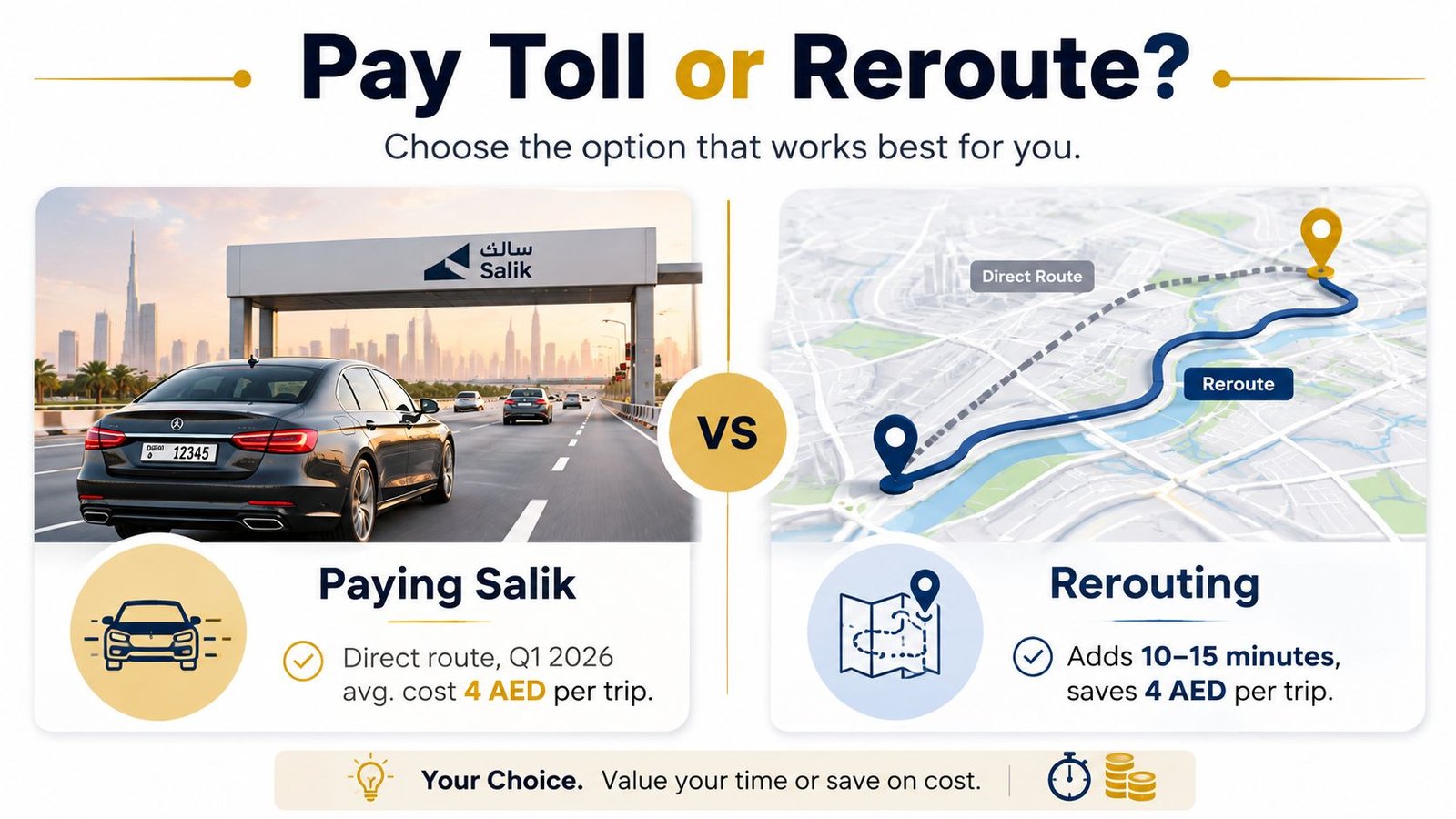
The question is not how to pay Salik online. It is whether the trip should go ahead on that route at all. Dubai's toll setup now uses variable dynamic pricing, so peak crossings cost more than off-peak ones, and that changes the decision for every executive run, airport pickup, and fleet movement.
Route discipline matters because the bill is no longer flat. If a car is crossing at the wrong time, the toll can be the smaller problem. The bigger cost is wasted time, missed slots, and a driver sitting in traffic when the job could have been planned better.
Where routing beats payment discipline
A DXB pickup at peak time is the obvious case for paying and moving on, because the schedule usually matters more than the toll. A Dubai to Abu Dhabi run outside the busy window may be better handled by shifting departure time if the client can tolerate it. A Business Bay to Dubai Marina movement in the middle of the day is exactly the kind of short city trip where you should check the route before you tap pay, especially if the day also includes a longer transfer later, such as a leisure stop on the way to Fujairah tourist spots.
Use the trip, not habit, to decide. Executive travel, airport transfers, and chauffeur work run on time pressure, so the route choice should be set before the payment step. Pay the toll when speed matters. Reroute when the schedule gives you room.
Troubleshooting Common Salik Online Payment Issues
The most common Salik payment issues are declined cards, stuck transactions, and plate-entry typos, and each one has a straightforward fix. A declined card usually means the card details are wrong, the bank has blocked the payment, or the portal needs a different card. Apple Pay or Samsung Pay problems usually come from the default card setup on the device, so check that first before you try the payment again.
If a transaction looks stuck, wait briefly, then check the balance again instead of paying twice. If the balance still shows zero after payment, open the receipt and transaction reference before you call support. A plate or tag typo needs to be corrected right away, because the money can land on the wrong record and create a bigger headache later.
If the app gives you no clear answer, call 800-72545 inside the UAE or +971 4 2335000 internationally. Keep the receipt, the plate number, and the tag ID ready when you call.
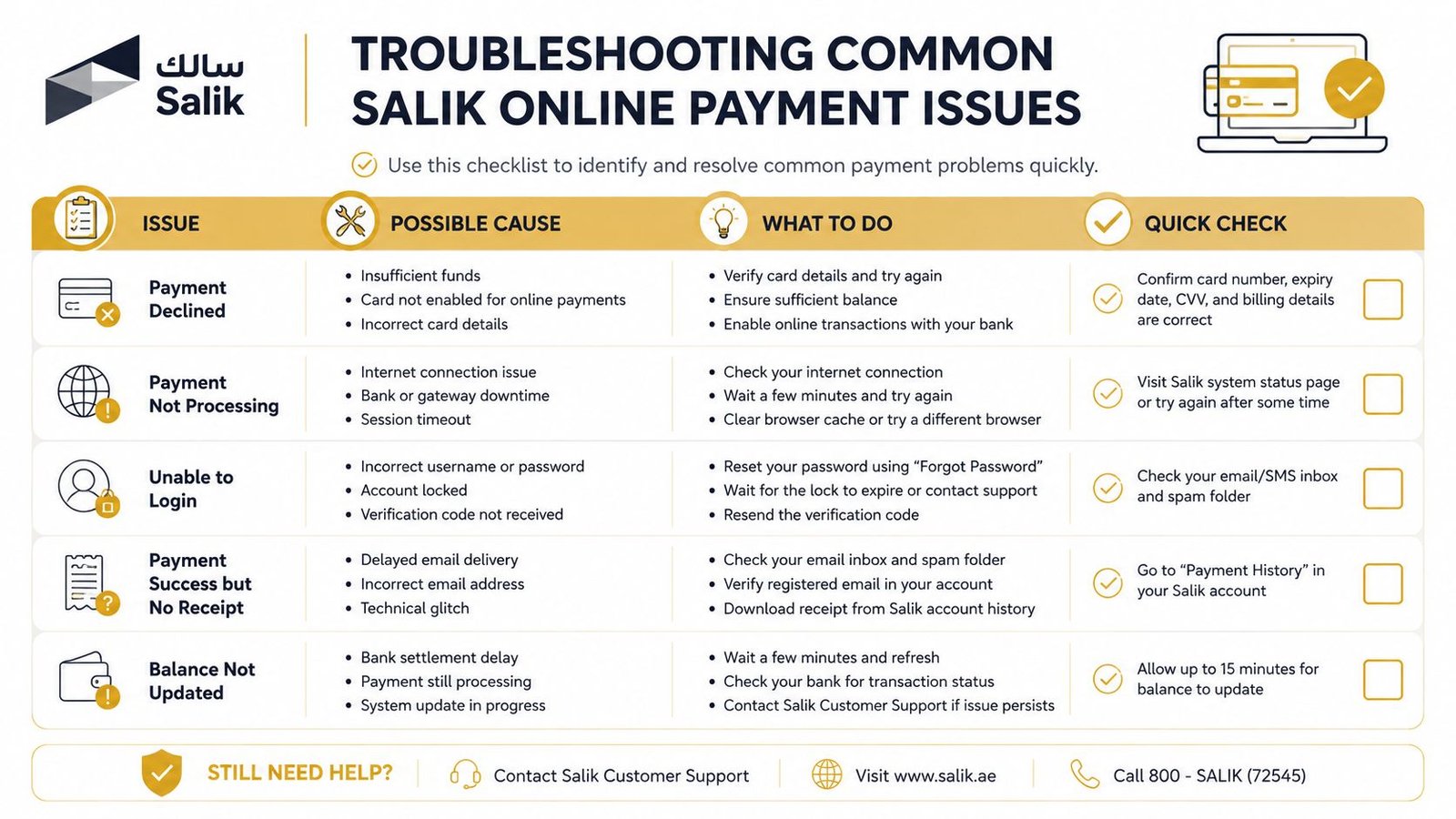
Screenshot this checklist for next time, verify the plate, confirm the tag, check the minimum top-up, keep the receipt. The minimum top-up can vary by portal, so do not assume the same amount applies everywhere. That is the fastest way to avoid a support call on the next recharge.
Book Your Chauffeur Service
Fast booking support for airport transfers, chauffeur service, and private car with driver in Dubai.
WhatsApp: +971 525 579 638
Email: booking@nsbluxurytransport.com
Website: www.nsbluxurytransport.com