
You just watched a Dubai-based trip go sideways in the worst possible way. The flight's cancelled, the hotel won't refund the first night, and your driver is already at the airport curb while you're trying to figure out who pays for the mess. That's exactly where credit cards with travel insurance matter, but only if you know what your card covers, how to activate it, and how fast you can file a claim.
For UAE travellers, this is not a minor perk. It's a practical risk-management tool for business trips through DXB, family holidays with multiple bookings, and multi-leg itineraries where one delay can ripple into several non-refundable costs. The problem is simple: many assume their premium card has them covered. However, the details matter, and the fine print decides whether you get reimbursed or eat the loss yourself.
Table of Contents
- Why Credit Card Travel Insurance Matters for UAE Travellers
- Core Travel Insurance Benefits on Premium Credit Cards
- Common Exclusions and Coverage Limits You Must Know
- How Coverage Is Activated and the Payment Requirement
- Is Card Insurance Enough for High-Value UAE Outbound Trips
- How to Evaluate and Compare Card Travel Insurance Policies
- The Claim Filing Process and Deadline Risks for GCC Travellers
- Final Decision Criteria and Recommendations for UAE Travellers
Why Credit Card Travel Insurance Matters for UAE Travellers
A Dubai executive books a premium cabin, pays for a hotel near the airport, and reaches DXB only to hear the flight has been pushed back overnight. The card in his wallet may cover the hotel, the meal receipts, and part of the rebooking pain, but only if the trip was charged correctly and the claim is filed on time. That is why credit cards with travel insurance matter before the booking is final.
For UAE travellers, the details decide whether the benefit pays or fails. Many cards advertise travel protection, but the issuer, the card tier, and the payment method matter far more than the logo on the front. Families, expatriates, and business travellers here usually book expensive international itineraries, so a weak benefit package can turn a simple disruption into a refund dispute.
A practical example is a Dubai-to-Saudi business run with a chauffeur transfer, an airport connection, and a return leg that slips by a day. On a trip like that, even a short delay can affect hotel nights, ground transport, and meeting schedules, so Dubai-to-Saudi chauffeur transport is the kind of itinerary where card coverage should be checked before departure.
Practical rule: treat card insurance as a product feature you verify, not a perk you assume.
Travel protection is also uneven across the card market. As noted by American Express's travel insurance overview, premium card benefits can include trip interruption help, baggage support, and 24/7 traveler assistance, but those features vary by issuer and card product. That is the point UAE travellers miss most often. The card may help, but only within the rules written into the benefit guide.
This guide focuses on the parts that decide whether a claim pays out. You will see which benefits usually exist, where exclusions bite, why the payment method controls eligibility, and when standalone travel insurance still makes more sense for a Dubai-to-Europe or Dubai-to-Asia itinerary. The goal is simple, compare the protection against the value of the trip, not against a marketing brochure.
Core Travel Insurance Benefits on Premium Credit Cards
Premium cards usually package several travel protections, but the benefits are not interchangeable. The main categories are trip cancellation, trip interruption, trip delay, baggage delay and loss, rental car damage, and emergency medical or evacuation services. American Express says premium travel benefits can also include 24/7 traveler assistance for rerouting trips and replacing lost documents. American Express travel insurance overview
What each benefit actually does
Trip cancellation reimburses eligible non-refundable costs when a covered event stops the trip before it starts. Issuer benefit guides and card comparison resources show that premium-card limits can be generous, but they still depend on the card and the exact benefit terms. Squaremouth's credit card travel insurance guide Citi travel protections overview American Express travel insurance overview
Trip delay helps with hotel, meals, toiletries, and similar expenses after a qualifying delay. Issuer guidance confirms that reimbursement depends on the card's rules and the claim process, so the practical value comes from the threshold, the documentation, and the eligible expense list. Chase travel insurance basics
Baggage delay and lost luggage matter when a Dubai-to-London or Dubai-to-New York route ends with your bag arriving late or not at all. Premium card guides also point to trip support services and baggage help, which can reduce the scramble when your luggage does not show up with you. Squaremouth's credit card travel insurance guide
Medical evacuation is the benefit many travellers underestimate. Premium-card examples commonly include evacuation support, and that matters far more than lounge access or points multipliers when a trip goes wrong outside the UAE. Chase travel insurance basics
A Dubai itinerary with multiple airport hops, such as an arrival transfer after a long-haul flight, needs more than a headline benefit. airport transfer coverage is exactly the sort of detail families and executives should check before departure, because a card benefit that does not match the actual trip pattern is poor protection.
The part most people miss
A benefit can exist on paper and still be useless if the trip was never charged correctly. The better question is what specifically activates the coverage, and what leaves you outside the policy.
Premium does not mean complete. Premium usually means structured, capped, and conditional.
Common Exclusions and Coverage Limits You Must Know
The biggest mistake travellers make is reading the benefit headline and ignoring the exclusions. Card travel insurance usually sounds broader than it is, and the gaps show up exactly when you are tired, delayed, or dealing with a family disruption. Read the certificate, not the marketing page.
What gets excluded first
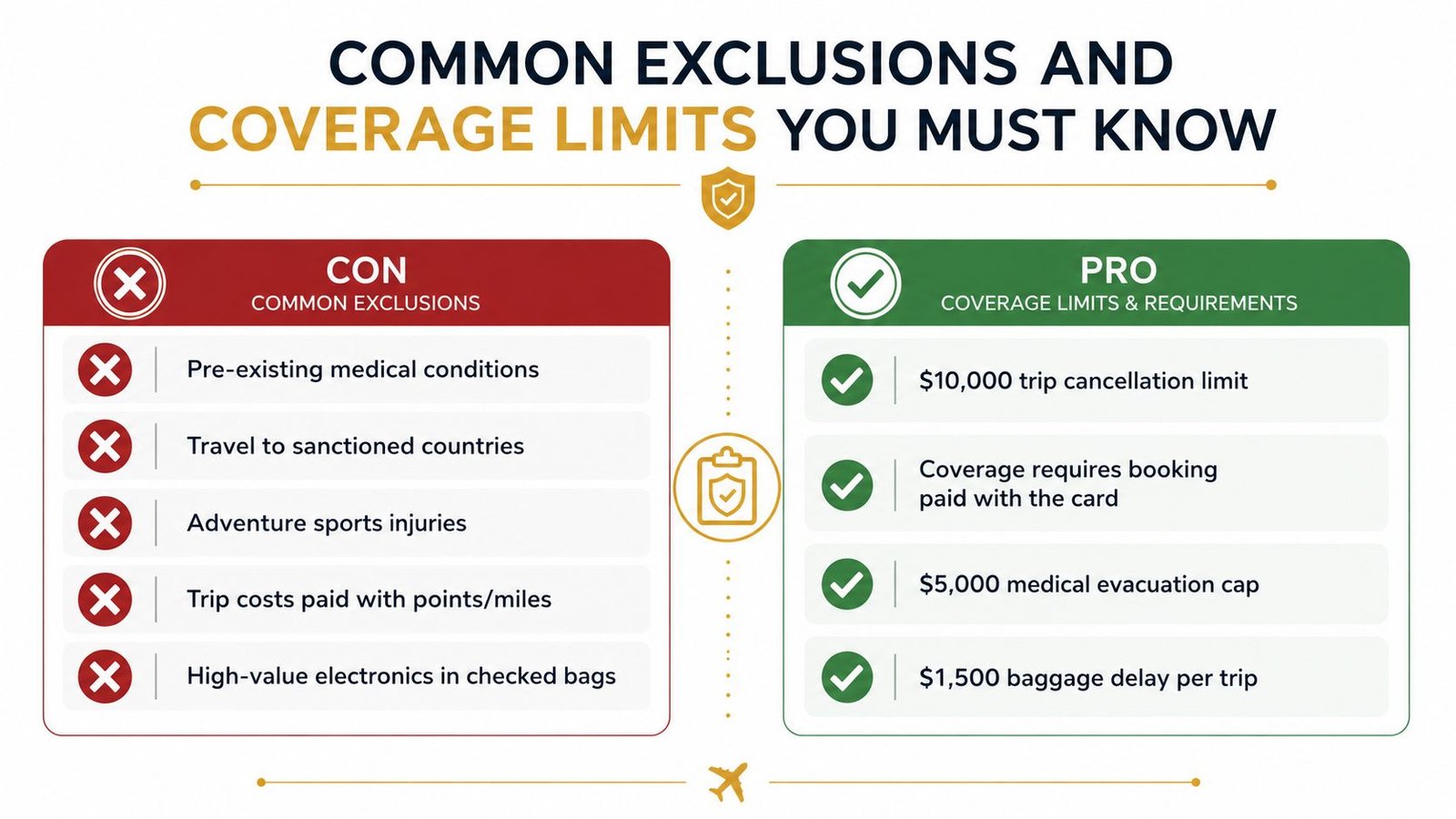
Pre-existing medical conditions are a common exclusion, along with high-risk or adventure activities, travel to sanctioned destinations, unattended baggage, and incidents involving alcohol or drug use. Those rules matter because they can wipe out a claim even when the trip was correctly charged to the card. The insurer is not looking for a reason to help, it is looking for a reason the loss sits outside the policy.
A claim fails faster on an exclusion than on a missing receipt.
Coverage caps matter just as much. On many premium-card policies, one benefit can look generous while another stays surprisingly tight, so the headline figure tells you very little about what you can recover. That split is why you should read the schedule of benefits line by line, especially if your trip involves business-class fares, multiple family members, or expensive hotel nights.
Why limits matter on luxury trips
A family holiday with premium hotels, intercity transfers, and several paid tickets can outgrow a modest cancellation cap very quickly. Even when the card covers a covered event, the reimbursement ceiling may leave a meaningful gap. That gap is the difference between partial relief and real protection.
A practical example is a Dubai departure with a transfer, a connecting flight, and a first-night booking in another city. If one part of the itinerary fails, the card may only repay the covered slice, while the rest stays on you. For UAE travellers, the issue is often not whether the benefit exists, but whether it keeps pace with the way the trip is booked.
Read the certificate, not the summary
The most useful habit is to scan for exclusions before you book. Look for language around family members, ticket classes, activity types, and what counts as a covered disruption. If you travel from the UAE often, the key question is whether the policy fits your actual travel style, not whether it sounds generous.
Also check the trip logic at the ground level. A card policy that looks fine on paper can still fall short if your itinerary depends on a specific airport handoff, a chauffeur pickup, or a route that changes the moment a flight slips. Review your route details against local markings and pick-up points, including a quick look at UAE road signs for travellers and drivers, so you know where confusion could create a claim dispute later.
How Coverage Is Activated and the Payment Requirement
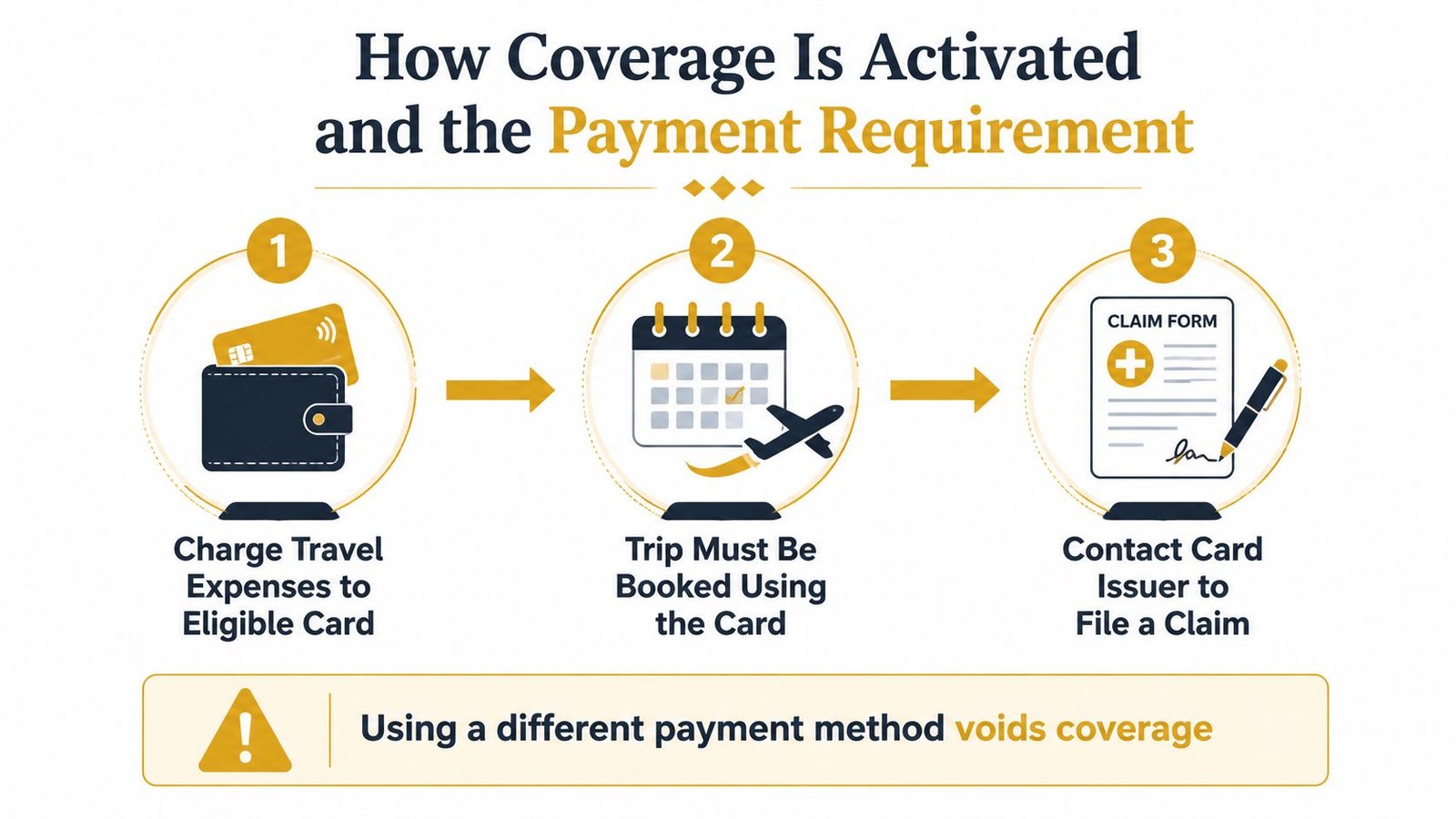
Card travel insurance is usually conditional on payment method. If you want the benefit to stick, charge the eligible trip expense to the right card, keep the account in good standing, and save proof of payment. Use another payment rail, and the coverage can disappear before the trip even starts.
What coverage covers
The trigger is usually straightforward when you use the card for airfare, cruise fares, rail tickets, or package-tour components. Some premium cards also extend benefits to immediate family members, but only if their travel was charged to the same eligible card. Split a family trip across cards and you create a weak claims file, especially when you are booking multiple rooms or separate flights.
Coverage works as a claims-based backup, not as open-ended medical insurance. It usually reimburses specific covered losses after the fact, which is very different from a policy that pays directly for broad overseas medical treatment. For UAE travellers, that difference matters because the problem is often the chain of pre-paid costs attached to the booking.
The practical rule
If you want the card to help, charge the trip cleanly and keep proof. Boarding passes, booking confirmations, and the card statement are basic evidence. If you use a corporate card, a spouse's card, or a bank transfer for part of the booking, check whether the benefit still applies before you assume anything.
Best practice: one eligible card, one clear booking trail, one claim file.
Rental-car coverage follows the same logic. If you are booking a GMC Yukon rental in Dubai or any other high-value vehicle, the payment method and the rental contract both need to line up with the card terms. If either one is messy, the claim can become a fight later.
A clean route to the airport matters just as much as a clean payment trail for the trip itself, and airport taxi transfers are easiest to manage when the service is booked and documented properly.
Is Card Insurance Enough for High-Value UAE Outbound Trips
For a quick weekend break, card insurance may be enough. For a family moving through multiple cities, with non-refundable hotels and fixed transfers, it often isn't. The UAE travel profile is too large and too international to rely on optimism. Dubai International handled 92.3 million passengers in 2024, its busiest year ever, and Dubai welcomed 18.72 million overnight visitors in 2024. VisitorsCoverage on Dubai travel demand
Where the gap shows up
The core issue is trip value versus cap. A premium card might offer strong protection on one line item, but the total exposure on a high-end itinerary can be much higher than the reimbursable ceiling. That matters for UAE residents booking luxury hotels, family suites, or multi-stop trips where one delay affects several bookings at once.
| Trip Scenario | Estimated Trip Cost | Typical Card Cancellation Cap | Coverage Gap |
|---|---|---|---|
| Solo business trip from Dubai with one hotel and one flight | Qualitatively moderate | Qualitatively limited | Small if the booking is simple |
| Family holiday with multiple rooms and transfers | Qualitatively high | Qualitatively limited | Often meaningful |
| Multi-leg long-haul trip with several non-refundable components | Qualitatively very high | Qualitatively limited | Often substantial |
My blunt recommendation
Use card insurance as a backup for simple itineraries. If the trip includes expensive hotels, family members, long-haul connections, or multiple paid segments, compare it against standalone travel insurance before you book. The question is not whether the card has a benefit. The question is whether the cap and exclusions match the amount you stand to lose.
For family travel planners, the Dubai to Oman family travel guide by private chauffeur is a useful reminder that cross-border trips have more moving parts than a simple return flight.
How to Evaluate and Compare Card Travel Insurance Policies
A card with strong travel perks can still be a poor choice for insurance. Start with the policy wording, because that is what controls the claim, not the glossy benefits page.
The checklist that actually matters
First, confirm the coverage type. Check whether the card covers trip cancellation, medical expenses, and baggage protection, or whether it only gives you one weak benefit and calls it a package. Then check the benefit limits and make sure you understand the maximum payout for each category.
Read the exclusions line by line. The policy should spell out what is not covered, and that list matters more than the headline benefit. Look for gaps around pre-existing conditions, high-risk activities, unpaid companions, and trips booked partly outside the eligible payment rules.
Then check the activation rules. Some cards require the full trip cost to be charged to the eligible card, while others only protect the portion paid that way. If the rule is unclear, assume the insurer will interpret it strictly.
If the activation rule is vague, assume the claim process will be strict.
Next, review the claims process and any deadlines for filing and sending documents. For UAE and GCC travellers, that matters because work trips, family trips, and connecting itineraries often cross time zones, and a deadline can pass faster than you expect after a disruption.
Look at the extras only after the core cover is clear. Travel assistance hotlines, rerouting support, and rental car benefits can help in a difficult trip, but they do not fix a weak insurance base. If the main policy is thin, the extra perks do not change the risk.
A simple comparison method
Put two or three cards side by side and compare the same fields in the same order. Do not compare marketing pages. Compare the certificate wording, then ask which card fits your real travel pattern from Dubai, not a once-a-year fantasy itinerary.
Use the issuer's benefits guide as your primary reference, then check a consumer comparison that explains how card protections are triggered, such as a policy breakdown from NerdWallet's credit card travel insurance guide. That gives you a cleaner picture than a sales page full of vague promises.
The UAE road signs guide sounds unrelated, but the rule is the same. Read the rules before you are already delayed, already at the airport, or already trying to prove your claim.
The Claim Filing Process and Deadline Risks for GCC Travellers
A claim doesn't start with the insurer paying you. It starts with paperwork, timing, and a clean record of what happened. CNBC notes that claim-filing windows can be as short as 20 days for some issuers and 60 days for others, which is exactly where busy GCC travellers get caught out. CNBC on credit card travel insurance claims
What you usually need
The file normally includes the booking confirmation, proof that the trip was charged to the eligible card, original receipts, and the incident evidence itself. Depending on the claim, that can mean airline delay documents, a police report for stolen baggage, or medical records. If the insurer asks for a document, send it fast and keep copies of everything.
Time zones create a second layer of risk. A traveller moving through Gulf, European, and Asian zones can misunderstand when the deadline starts, especially after a long disruption and a late-night arrival. Don't guess. Start the claim as soon as the issue is documented.
Where claims go wrong
Claims usually fail because the traveller paid with the wrong card, filed late, or submitted incomplete evidence. Some claims also stall because the wording of the benefit didn't match the traveller's assumption, especially around delay thresholds and covered companions.
Practical move: begin the claim from the airport or hotel, not after you've returned home and unpacked.
For GCC travellers, the issue is operational discipline. The card benefit may be decent, but if the issuer wants a prompt, document-heavy claim and you miss the window, the protection is worthless in practice. That's the part glossy card brochures never emphasise.
Final Decision Criteria and Recommendations for UAE Travellers
Use card insurance when the trip is simple, the payment trail is clean, and the insured value isn't far above the card's limits. That works best for solo business travellers and short, direct itineraries where delay or baggage issues are the main risk. Families on expensive holidays should be more cautious, because one disruption can multiply across several tickets, rooms, and transfers.
If you travel often between Dubai, Abu Dhabi, Riyadh, Muscat, or other regional hubs, read the certificate before every major booking. Look for the payment trigger, the exclusions, the delay threshold, and the filing deadline. If any of those are vague, treat the card as a backup, not the main protection.
For luxury or multi-leg trips, standalone insurance is often the safer call. It's cleaner, broader, and less dependent on the exact card you used to pay. Card insurance is useful. It just isn't the whole answer.
Book your ride with NSB Luxury Transport for reliable airport transfers, chauffeur services, and cross-border travel across Dubai, Abu Dhabi, and the GCC. If you want a ground-transport plan that matches the same level of care you expect from your travel protection, visit NSB Luxury Transport and book with confidence before your next trip.
Book Your Chauffeur Service
Fast booking support for airport transfers, chauffeur service, and private car with driver in Dubai.
WhatsApp: +971 525 579 638
Email: booking@nsbluxurytransport.com
Website: www.nsbluxurytransport.com