
A VIP's flight lands at DXB, the chauffeur clears the terminal, the convoy joins Sheikh Zayed Road, and then the trip starts interacting with the actual UAE road system. There are toll gantries, speed cameras, lane discipline, passenger safety checks, and, in some cases, roadside inspections that can stop a service if the vehicle or paperwork isn't right. For professional drivers, tourists, and fleet operators, uae traffic rules aren't a background detail, they shape whether a journey stays smooth or turns into a delay.
A lot of confusion comes from assuming the rules are static or only about speeding. In practice, the UAE ties road use to vehicle condition, passenger behaviour, enforcement intensity, and, in certain cases, risk-triggered police powers. This guide breaks those pieces down in plain language, so chauffeurs, operators, and travelling families can plan correctly, stay compliant, and avoid avoidable disruption. For travellers who want a structured service around those realities, the transport context matters as much as the route itself, and a useful starting point is this Dubai airport overview.
Table of Contents
- UAE Traffic Law Framework and Roadworthiness Gate
- Essential Traffic Rules for Safe Driving
- Enforcement Mechanisms and Penalties
- Rules for Tourists and Professional Chauffeurs
- How to Pay and Contest Fines in the UAE
- Compliance Best Practices for Luxury Transport Operators
- Conclusion
UAE Traffic Law Framework and Roadworthiness Gate
A driver can be fully licensed and still be stopped by the system if the vehicle itself fails the compliance check. The UAE traffic framework works on two layers at once. One layer is the national rule set, which sets the baseline for licensing, road use, penalties, and safety standards. The other is emirate-level administration, which means registration, tolls, enforcement, and service channels can differ by location even when the legal logic stays the same.
For fleet managers, the most important operational idea is the roadworthiness gate. Under UAE legislation, a vehicle cannot be used on the road unless it is licensed, in good technical condition, and compliant with state-approved specifications, and registration or renewal requires technical inspection by the licensing authority or approved inspection centres UAE legislation on vehicle requirements. That is a legal control point, not a routine paperwork step. It keeps an unfit vehicle out of service until the defect or compliance issue is corrected.
Why this matters for operators
For sedans, SUVs, vans, and mixed chauffeur fleets, inspection timing has to sit inside the maintenance calendar. A brake fault, lighting issue, or non-compliant modification is no longer just a workshop matter. It can block the vehicle from returning to service on schedule.
The official road-safety platform also states that changes to the structure, engine, or colour require prior approval UAE government road-safety platform. That matters in luxury transport, because cosmetic changes and performance changes can both create compliance problems if they are carried out first and authorised later. The same rule applies across a premium fleet, from executive sedans to specialized models like a G-Class rental in Dubai.
Practical rule: treat inspection dates and modification approvals as dispatch-critical tasks, not admin chores.
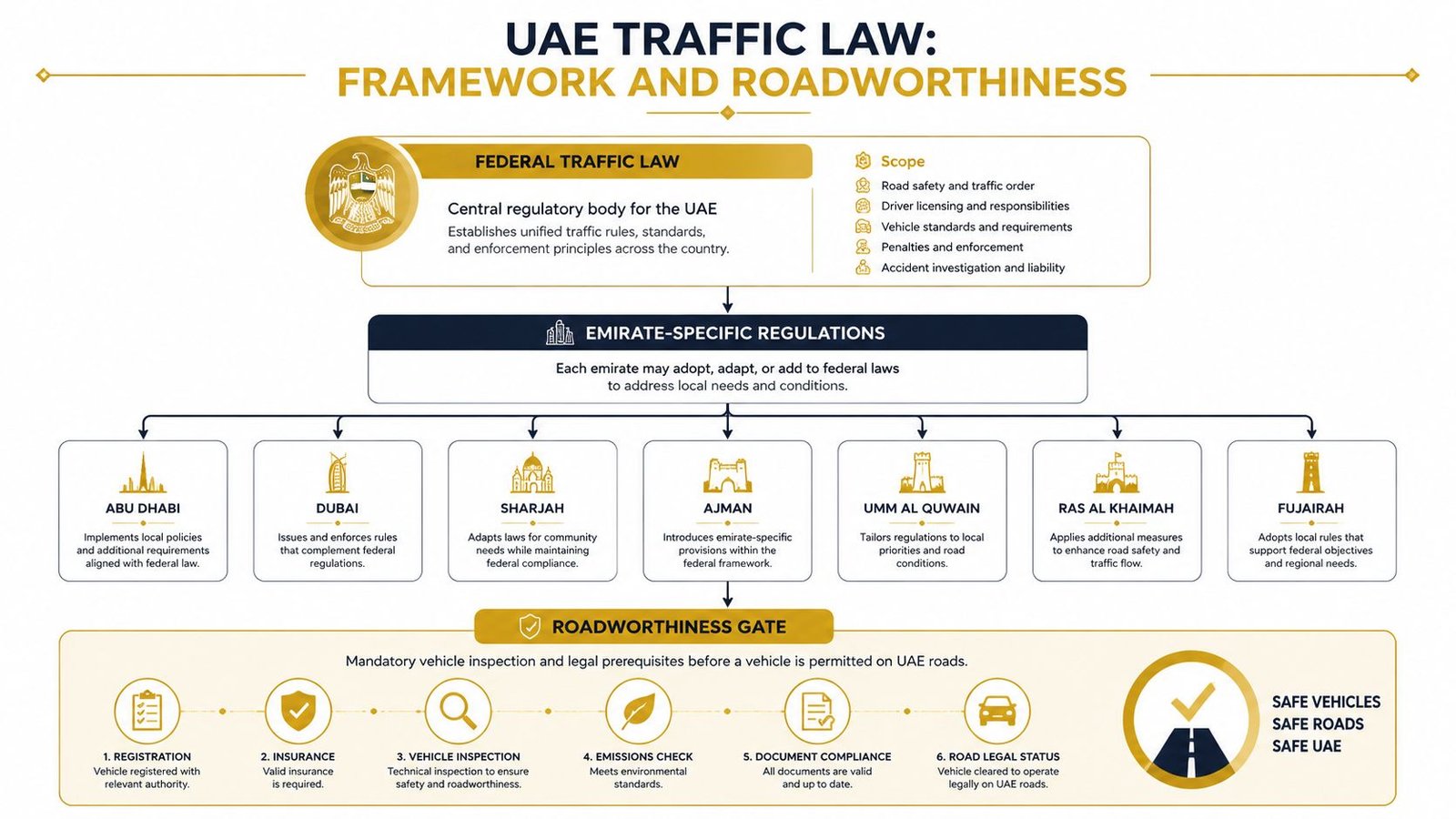
The framework also shapes enforcement risk in a practical way. A vehicle that looks acceptable on the surface can still attract attention if its paperwork, inspection status, or approved specification does not match what is on the road. That creates hidden exposure for operators who focus only on appearance and miss the compliance layer underneath.
A fleet that aligns servicing with registration cycles is less likely to face a last-minute vehicle swap, a failed inspection, or a cancelled booking. For premium transport, that protects legal continuity and service quality on airport transfers, inter-emirate trips, and corporate movements where timing matters.
If a vehicle would fail inspection on paper, it should not be scheduled for a client pick-up in practice.
Essential Traffic Rules for Safe Driving
A chauffeur can have a clean route, a polished vehicle, and a punctual pickup, then still face a problem because of a basic rule that was missed before departure. The UAE's core driving requirements are clear, but they are easy to breach if a driver carries over habits from another market. Seat belts, child restraints, phone discipline, and zero-tolerance impairment standards are required controls, and the driver has to confirm them before the car moves.
Seat belts and child seats
Every passenger must wear a seat belt, including people in the back seat. A UAE traffic guide states that failing to do so can trigger a AED 400 fine and four black points traffic rules guide. The same source says children under four years old must use a child safety seat, with the same penalty.
For chauffeur operators, the responsibility starts before departure and not after the doors close. The driver has to check that every passenger is restrained, especially on family transfers, hotel runs, and airport trips where people are often tired, talking, or focused on luggage instead of compliance. A seat belt rule may sound simple, but in practice it works like a final boarding check. If one passenger is unbuckled, the vehicle is not ready.
These rules matter on inter-emirate journeys too, including trips such as how to travel from Abu Dhabi to Dubai, where enforcement expectations do not change just because the route is familiar.
Phones and impairment
Handheld phone use while driving also carries a AED 400 fine and four black points driving in Dubai guide. In executive transport, this is a common operational trap. Drivers may feel pressure to answer calls, read messages, or adjust navigation by hand, but every one of those actions pulls attention away from traffic at the moment it is needed most.
The safer approach is simple. Use hands-free systems, set the route before moving, and keep the driver's phone out of hand use entirely. If a call or message demands attention, the vehicle should stop first.
The UAE also applies a zero-tolerance approach to drink-driving driving in Dubai guide. For professional drivers, that standard leaves no grey area. Any impairment risk should remove the driver from service, because a chauffeur is not just operating a vehicle, the chauffeur is carrying legal responsibility for everyone inside it.
Common mistakes that create trouble
- Back-seat passengers skipping belts: this is one of the easiest violations to prevent, and one of the easiest to overlook.
- Drivers handling phones at junctions: even a quick glance can become a fine-worthy offence.
- Families using the wrong child seat setup: the issue is not whether a child looks comfortable, it is whether the restraint is suitable and secure.
- Assuming private hire is exempt: it is not.
| Traffic Offenses Penalties | Fine (AED) | Black Points |
|---|---|---|
| Seat belt not worn by passenger, including back seat occupant | 400 | 4 |
| Child under four without a safety seat | 400 | 4 |
| Handheld phone use while driving | 400 | 4 |
The practical standard is straightforward. Fit the child seat before departure, check every belt, and keep the driver's phone out of hand use entirely. That protects the passenger, the driver, and the operator's record at the same time.
Enforcement Mechanisms and Penalties
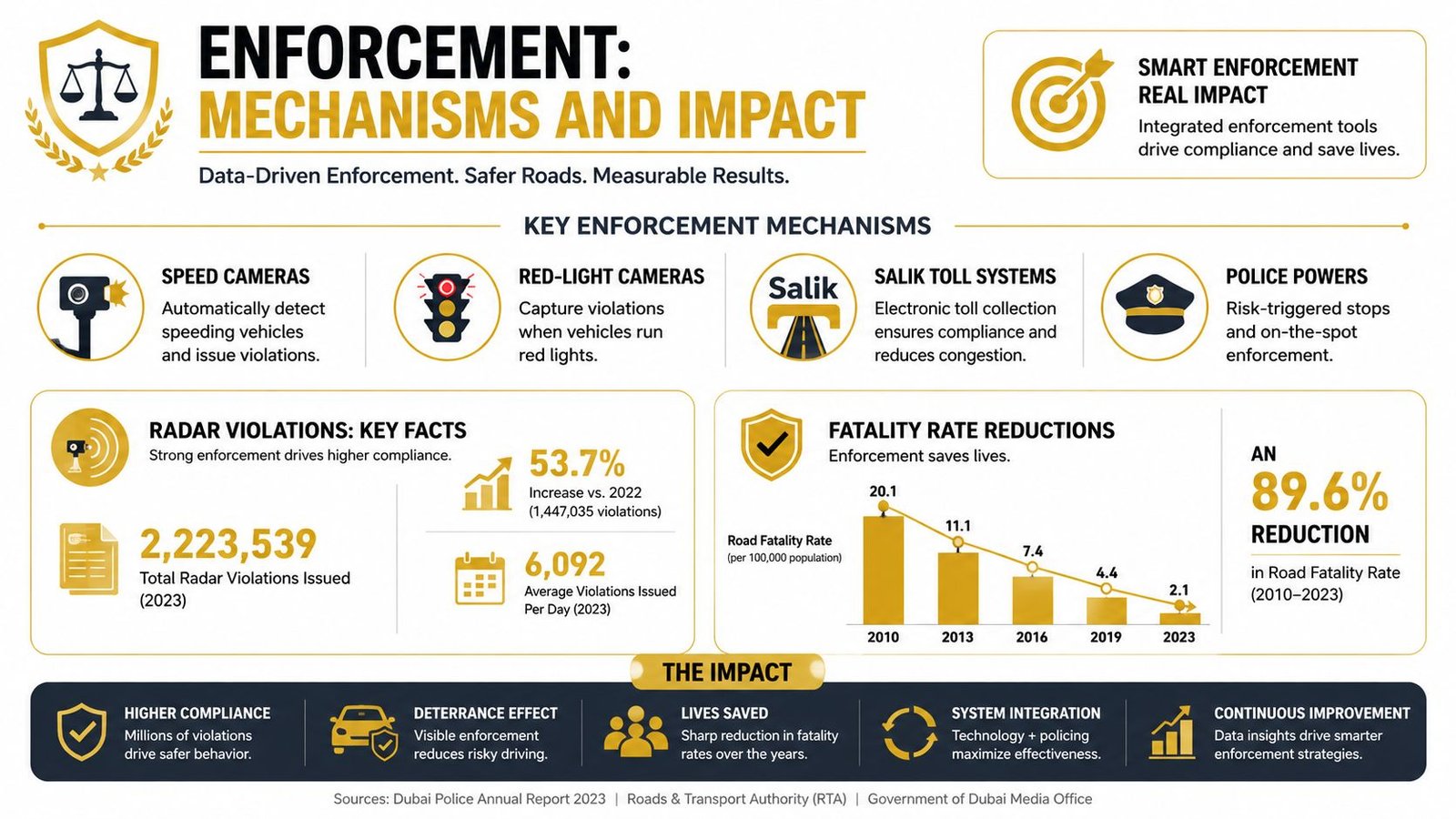
A driver in Dubai can do everything right on the road and still be caught by the enforcement system if the vehicle creates a compliance problem. That is the practical lesson from Dubai's enforcement record. In 2024, Dubai logged 2,070,338 radar violations, and authorities also reported a fall in traffic fatalities from 21.7 per 100,000 people in 2007 to 1.8 in 2024. Those figures show a regime built to detect risky behaviour early and follow through consistently, not a system that waits until a collision forces action.
What enforcement looks like in practice
Speed cameras and red-light cameras are only the visible layer. The operational effect extends to route choice, timing, and the pressure drivers feel to meet a booking without cutting corners. Toll systems such as Salik in Dubai also affect day-to-day planning, because a chauffeur has to weigh congestion, entry points, and time windows, not just the shortest route on a map. A route that looks efficient on paper can become a poor choice if it encourages rushing, late lane changes, or a last-minute stop in the wrong place.
Enforcement can also escalate quickly when conduct crosses into high-risk territory. The new traffic rules report says officers can arrest drivers on the spot in serious situations, including causing death or injury, major property damage, driving under the influence, reckless driving, false identity or document submission, and fleeing an accident scene or a police order. It also says vehicles can be impounded if they are unfit for road use, including cases where key components are missing or an unlicensed person is driving. A separate UAE traffic rules update describes how these penalties sit alongside black points and heavier fines, which is why operators have to treat enforcement as a live risk, not a back-office issue.
For fleet managers, the exposure is wider than the fine itself. A stopped or impounded vehicle can wipe out a shift, upset a client schedule, and damage the operator's record at the same time. The route may still be legal, yet a poor decision at the curb, in a pickup lane, or after a warning from police can turn a routine job into a service failure.
The roadworthiness gate matters here as much as the camera network. A vehicle that looks ready for work but is missing required equipment, carrying an unlicensed driver, or showing signs of unsafe use can be taken out of service. That is why professional operators should treat inspection, dispatch, and handover as one process. A chauffeur who checks the car at the start of a shift is not being cautious for its own sake, the chauffeur is reducing the chance that an enforcement officer becomes the last checkpoint.
Operational takeaway: the UAE's enforcement system is designed to stop risk early, before it becomes a crash, a seizure, or a lost booking.
Black points are only part of the exposure for fleet operators. A violation tied to speed, roadworthiness, or a serious incident can trigger delays that spread through the rest of the day. Reliable operators plan for camera enforcement, toll timing, and roadside checks as part of the route design itself, the same way they plan fuel, pickup windows, and vehicle assignment.
Rules for Tourists and Professional Chauffeurs
A tourist can know the road signs and still make a poor call at the wheel. In the UAE, traffic moves on the right-hand side with left-side steering, so drivers from left-driving countries need a quick reset before setting off. The basic habits also matter, drivers must avoid tailgating, dangerous overtaking, texting while driving, and using the hard shoulder.
What chauffeurs need to adapt to
Professional drivers face a different risk, overconfidence. A chauffeur may know the city well and still create trouble by following a passenger's urgent request to stop, turn, or collect someone in a place that is not allowed. The law does not pause at the curb, the hotel entrance, or the airport pickup lane.
Route planning changes the job, not just the map. Official reporting on UAE traffic-rule reporting noted stricter rules and heavier fines from 29 March 2024, and it also mentioned a 2024 ban on heavy vehicles over 65 tonnes from roads. For chauffeurs, that means route choice, pickup timing, and vehicle assignment have to be checked together before the trip starts.
A chauffeur service has to match the vehicle to the assignment. A sedan may suit one client and fail another, while a cross-border run may need different paperwork and a wider departure buffer than a simple city transfer. Many operators also use chauffeur service support in Dubai to keep those decisions tied to the booking instead of leaving them to a rushed hire.
Tourist habits that cause problems
- Stopping wherever the passenger wants: the stop must be legal, not just convenient.
- Using the shoulder to save time: that is prohibited.
- Assuming a rental car rule is the same as a private car rule: the requirements can differ.
- Forgetting passenger behaviour matters too: seat belts and safe boarding still count.
A good rule for visitors from another road culture is simple, slow the decision-making down. Speed does not solve confusion at a junction, and it certainly does not make an unsafe stop lawful.
For operators carrying visitors, families, and business guests, the cleanest practice is to brief the passenger before the ride begins. Explain where pickup happens, how seat belts are handled, and why the driver may refuse an unsafe stop. That keeps the service calm and avoids arguments later.
How to Pay and Contest Fines in the UAE
When a traffic fine lands, the first mistake is paying blindly without checking the details. The second mistake is ignoring it and hoping it disappears. The right approach is to verify the violation, match it to the right vehicle or driver record, then decide whether to settle it or challenge it through the relevant authority channel.
Paying fines
Most drivers in the UAE use the police app or official digital portal for their emirate, or they pay at authorised service counters. The practical goal is to make sure the fine number, plate details, date, and offence category match the actual event before payment. Keep the receipt immediately, because transport teams often need it for reconciliation, insurance files, or fleet records.
If a route also involves tolls, keep those records separate from traffic fines. For example, if you need to settle Salik-related charges, this Salik payment page is the relevant operational reference within the transport workflow.
Contesting fines
Disputes work best when evidence is collected early. Save dashcam footage, booking logs, route screenshots, pickup timestamps, and any client messages that show why the vehicle was where it was. If the fine looks wrong, don't guess, ask for the exact violation details and check whether the plate, time, and location line up.
The strongest challenge files usually include:
- Clear proof of location: GPS traces, booking records, or toll logs.
- Vehicle identity checks: plate number, make, and assignment record.
- Timing evidence: arrival and departure timestamps.
- Supporting documents: insurance, registration, or driver assignment notes if relevant.
Practical rule: a clean paper trail matters more than a long explanation.
Deadlines and escalation steps vary by emirate and authority, so the safest move is to act quickly after the notice appears. If the matter involves a formal error, send the evidence through the official channel, keep copies of everything, and wait for a written outcome before assuming the case is closed.
For fleet operators, discipline is administrative. Every fine should be logged, paid or disputed on time, and tied back to the driver and vehicle record so the same issue doesn't repeat. That habit saves time and protects the service record.
Compliance Best Practices for Luxury Transport Operators
A luxury transport fleet stays compliant by treating every trip like a controlled operation, not a one-off booking. The vehicle, driver, route, and paperwork all need to line up before the car leaves the depot, because enforcement in the UAE can stop the service at the roadside instead of waiting for a later notice.
Build compliance into dispatch
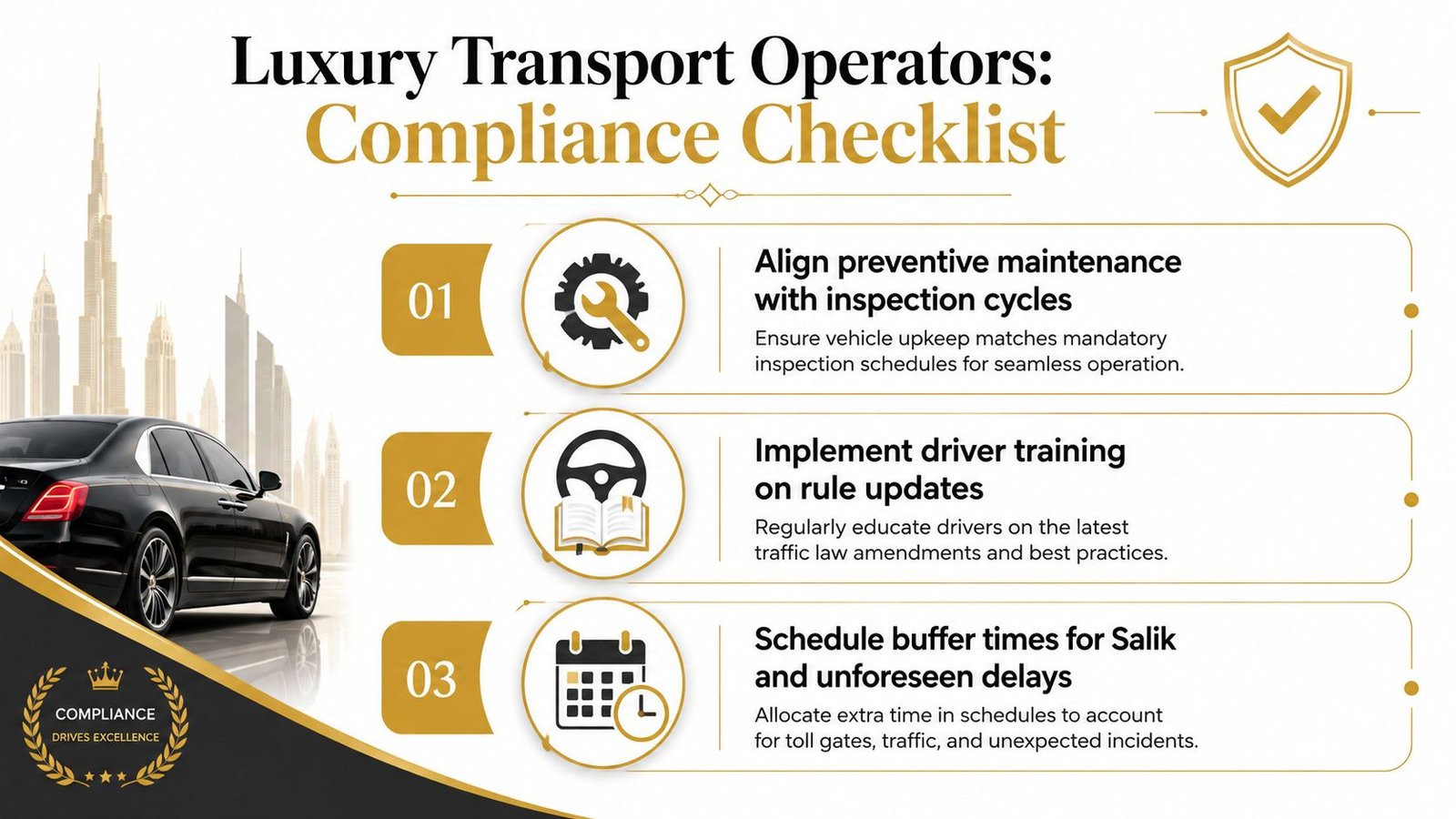
Maintenance timing should sit inside the dispatch process. If servicing is planned without regard to inspection cycles, a vehicle can look available on paper and still fail the roadworthiness gate when it is needed most. Driver training needs the same treatment, with clear briefings on rule updates, passenger restraint checks, phone restrictions, and the right response when a pickup point changes or the road situation shifts.
A dispatch team that builds these checks into the booking flow reduces avoidable surprises. It is much like checking a flight's load sheet before pushback, once the vehicle is in motion, the room for correction is far smaller.
Use buffers, audits, and assignment checks
Schedule buffers matter because UAE journeys are affected by tolls, traffic, and inspection delays. A chauffeur who has no margin often starts to rush, and rushed decisions are where many violations begin. Regular audits close the gap by showing patterns early, before an officer or camera does.
A practical assignment checklist should cover:
- Vehicle readiness: tyres, lights, brakes, registration, and inspection status.
- Passenger safety setup: seat belts available and child seats installed where needed.
- Driver readiness: licence, ID, route brief, and no impairment risk.
- Route planning: tolls, pickup restrictions, and alternate roads.
- Document control: registration, insurance, and booking confirmation.
Salik also needs to sit inside the same control system, because toll management affects both routing and billing. A compliance checklist infographic for luxury transport operators in the UAE, listing maintenance, training, and scheduling requirements. makes the point clearly, a clean compliance process is not only about safe driving, it also keeps the trip aligned with the operator's duty record.
Serious enforcement can also escalate fast, as noted in the new traffic rules report. That is why operators should treat fitness to drive, vehicle condition, and document control as operational gates, not admin tasks after the fact.
For premium transport operators, the standard should stay simple. A vehicle goes out only when it is roadworthy, a driver departs only with the correct documents, and a passenger trip begins only after the safety checks are done. NSB Luxury Transport works inside that compliance reality, and that is why process discipline matters more than promises.
Conclusion
Mastering uae traffic rules is about more than avoiding fines. It means understanding the roadworthiness gate, respecting passenger safety requirements, planning for cameras and tolls, and preparing for enforcement that can escalate beyond citations. For chauffeurs and operators, those details protect passengers, keep schedules intact, and reduce the chance of immobilisation or detention.
The strongest service providers treat compliance as part of the product. They inspect vehicles on time, brief drivers properly, and build route buffers into the day instead of pretending the road is predictable. That approach works for airport transfers, corporate journeys, family travel, and cross-emirate movements alike.
If you're managing chauffeur travel in Dubai or anywhere in the UAE, make compliance part of your booking standard, not an afterthought. Keep this guide close, check the official portals when rules change, and plan every trip as if enforcement could appear at the next junction.
Book your ride with NSB Luxury Transport. We provide chauffeur services, airport transfers, corporate transport, full-day car hire with driver, and intercity travel across the UAE with a focus on safety and compliance. Visit NSB Luxury Transport to plan your next trip with a professional team that understands UAE road rules and service reliability.
Book Your Chauffeur Service
Fast booking support for airport transfers, chauffeur service, and private car with driver in Dubai.
WhatsApp: +971 525 579 638
Email: booking@nsbluxurytransport.com
Website: www.nsbluxurytransport.com