

A Dubai executive often faces the same decision at short notice. A meeting in Riyadh is fixed, the agenda is important, and the key question isn’t only how to get there. It’s how to arrive focused, properly rested, and with no border issue turning into a lost half-day.
That’s why Dubai to Saudi travel needs more than a basic route summary. For some travellers, a flight is right. For others, the road connection is more practical, especially when timing, privacy, luggage handling, and direct point-to-point movement matter more than airport routines. Dubai welcomed 18.7 million international visitors in 2024, with travellers from Saudi Arabia making up a significant part of that regional movement, which highlights the demand for dependable travel on this corridor (Dubai tourism statistics overview).
This route serves business executives, family groups, VIP guests, airport travellers, and event attendees who need clarity on distance, documents, legal requirements, and understanding the trade-off between self-driving and a professionally managed journey. The difference is rarely just fuel. It’s fatigue, timing, border readiness, and how much friction you’re willing to absorb on the day.
Book a VIP Dubai to Saudi Private Transfer
Travel from Dubai to Saudi Arabia with a professional chauffeur and premium private vehicle. NSB Luxury Transport provides comfortable door-to-door transfers, flexible departure times, experienced drivers, and reliable cross-border travel for business trips, family visits, and VIP journeys.
View Dubai to Saudi Service Enquire on WhatsAppTable of Contents
- Your Premier Guide to Traveling from Dubai to Saudi Arabia
- Comparing Your Travel Options From Dubai to Saudi
- Planning Your Drive From Dubai to Saudi Arabia
- Essential Visas and Documents for Saudi Travel
- Why VIPs Choose a Dubai to Saudi Chauffeur Service
- How to Book Your Cross-Border Chauffeur
- Your Dubai to Saudi Travel Questions Answered
- Is Dubai to Saudi by road practical for business travel?
- How long should I realistically allow for the full journey?
- Is self-driving cheaper than a chauffeur?
- Why do premium chauffeur prices differ from ordinary car costs?
- Can this route work for Umrah, weddings, or family groups?
- What documents cause the most last-minute problems?
- Is a luxury SUV or executive van better than a sedan?
- Conclusion
Your Premier Guide to Traveling from Dubai to Saudi Arabia
A common scenario looks like this. A senior manager finishes meetings in Downtown Dubai, checks the next day’s calendar, and realises Riyadh can’t wait. Flying sounds quick at first, but airport transfers, check-in timing, baggage handling, arrival procedures, and the final city transfer all add layers. For a traveller who needs control over schedule and privacy, the road often becomes the more practical option.

The Dubai to Saudi route isn’t a niche movement. It’s part of a regular GCC travel pattern used by corporate travellers, families, tourists, and event guests who need a dependable corridor between the UAE and the Kingdom. What separates a smooth trip from a stressful one usually comes down to preparation. The strongest plans account for documents, insurance, vehicle eligibility, and border processing before the journey starts.
Who typically uses this route
- Corporate travellers: They need quiet cabin space, predictable scheduling, and direct arrival at offices, hotels, or residences.
- Families and groups: They often prefer keeping luggage together and avoiding multiple transfer points.
- VIP guests and event attendees: Privacy, discretion, and controlled timing usually matter more than chasing the lowest visible travel cost.
Practical rule: For cross-border road travel, the easiest journey is the one that removes avoidable decisions on the day itself.
The best approach depends on your priorities. If speed between airports is the only metric, flying has a place. If the journey needs to work door to door, with fewer handoffs and better control, road travel deserves a serious look.
Comparing Your Travel Options From Dubai to Saudi
The main choices are straightforward. You can fly, drive yourself, or use a private chauffeur. The mistake many travellers make is comparing only ticket price or fuel cost. That’s too narrow for a cross-border trip where timing, rest, border handling, and final-mile convenience all affect the outcome.
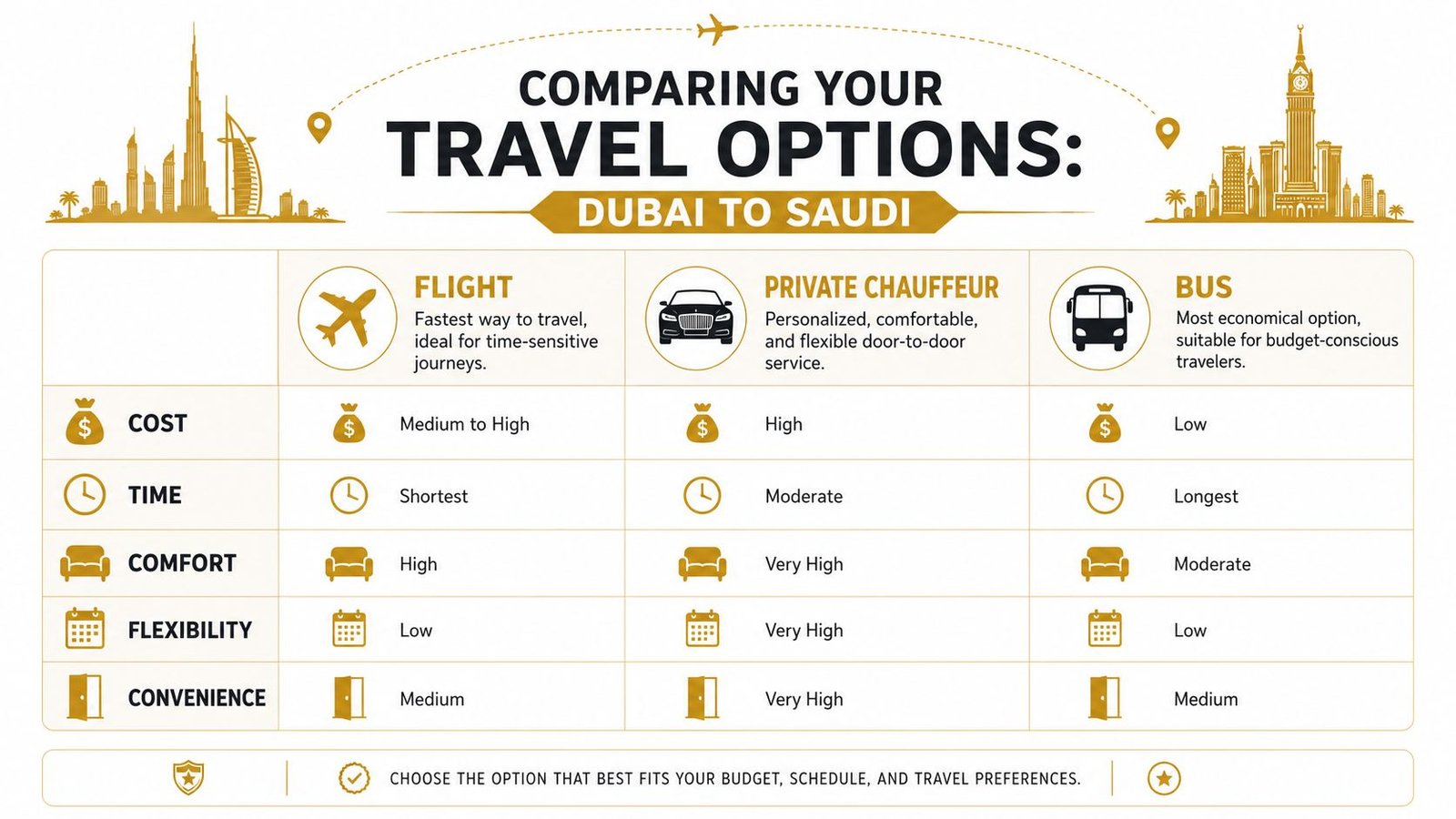
A useful comparison looks at the whole day. That means how much planning the trip requires, how many touchpoints can go wrong, whether you can work in transit, and how likely you are to arrive fresh enough for meetings, family commitments, or event schedules.
Dubai to Saudi Arabia Travel Comparison
| Feature | Private Chauffeur (NSB) | Self-Drive | Commercial Flight |
|---|---|---|---|
| Door-to-door convenience | Very high | Moderate | Moderate |
| Control over departure time | Very high | High | Low |
| Border handling stress | Low for passenger | High for driver | Not applicable for road border |
| Privacy | Very high | High | Limited |
| Ability to work during travel | High | Very low | Limited |
| Fatigue on arrival | Low | High | Moderate |
| Luggage flexibility | High | High | Limited by airline process |
| Best fit | VIP, executive, family, direct transfer | Confident road traveller | Time-sensitive airport-to-airport travel |
What each option does well
Commercial flight works when airport schedules align perfectly with your meeting or onward connection. It suits travellers who don’t mind check-in, terminal movement, and a separate transfer on arrival.
Self-drive gives control and can look cheaper on the surface. It suits travellers comfortable with a long road day, border formalities, and the responsibility of keeping every document and insurance requirement in order.
Private chauffeur is strongest when the traveller values comfort, discretion, and fewer moving parts. The same logic applies on other intercity premium routes, including Dubai to Abu Dhabi transportation, where schedule control often matters more than the headline fare.
The cleanest transport choice is usually the one with the fewest handovers. Every extra checkpoint, queue, or vehicle change adds friction.
Planning Your Drive From Dubai to Saudi Arabia
A Dubai to Saudi road journey often looks straightforward on a map. The actual test starts later, after hours on the highway, when the driver reaches the border tired and still has to present the right documents, answer inspection questions clearly, and keep the trip on schedule.
From Dubai to Riyadh, the drive is commonly estimated at about 980 km and roughly 9 to 10 hours, before any time spent at the Al Ghuwaifat to Al Batha border crossing is added. Travellers often budget AED 110 to AED 200 for one-way fuel in a standard vehicle and about AED 30 for vehicle entry costs, based on this Dubai to Saudi road trip guide.
The route is simple. The execution is not.
The highway segment is usually predictable. The operational risk is not. A self-drive plan asks one person to stay alert for a full-day run, manage passenger comfort, watch fuel timing, and then handle border formalities at the point when concentration is already dropping.
That trade-off matters for executives, families, and VIP travellers. A professional chauffeur service reduces the chance of small errors turning into expensive delays. The passenger arrives rested, documents are prepared in advance, and the driver is already familiar with cross-border procedure, vehicle compliance, and the practical rhythm of the route.
Border posts operate 24/7, but round-the-clock operation does not guarantee a fast crossing. Waiting time changes with traffic volume, inspection flow, and document checks. Keep passports, visas, vehicle papers, and charging access within reach instead of packed deep in luggage.
The same discipline applies on other GCC family and premium road trips, including this Dubai to Oman family travel guide by private chauffeur.
What self-driving costs on paper
The visible costs are usually the easiest to estimate:
- Fuel: A one-way estimate of AED 110 to AED 200 for a standard vehicle on the Dubai to Riyadh road route, as noted in the source above.
- Vehicle entry fee: Travellers commonly report around AED 30 at the border, from the same road guide.
- UAE tolls: Abu Dhabi’s Darb system applies toll charges on relevant routes. Current toll details are published on the Integrated Transport Centre Darb toll page.
The bigger cost is risk exposure
Self-drive comparisons often fall short. Fuel is measurable. Fatigue, border friction, and lost work time usually are not, until something goes wrong.
A long cross-border drive can cost more than petrol if the traveller arrives drained before a meeting, if the wrong insurance document delays entry, or if a family spends an extra hour at the checkpoint because papers were packed away or misunderstood. In premium transport, those are not minor inconveniences. They affect schedule control, privacy, and the quality of arrival.
I would treat this route as a logistics job, not a casual motorway run. For travellers who value time, comfort, and reduced border risk, the strongest case for a professional chauffeur is not that it saves fuel. It is that it protects the trip.
Essential Visas and Documents for Saudi Travel
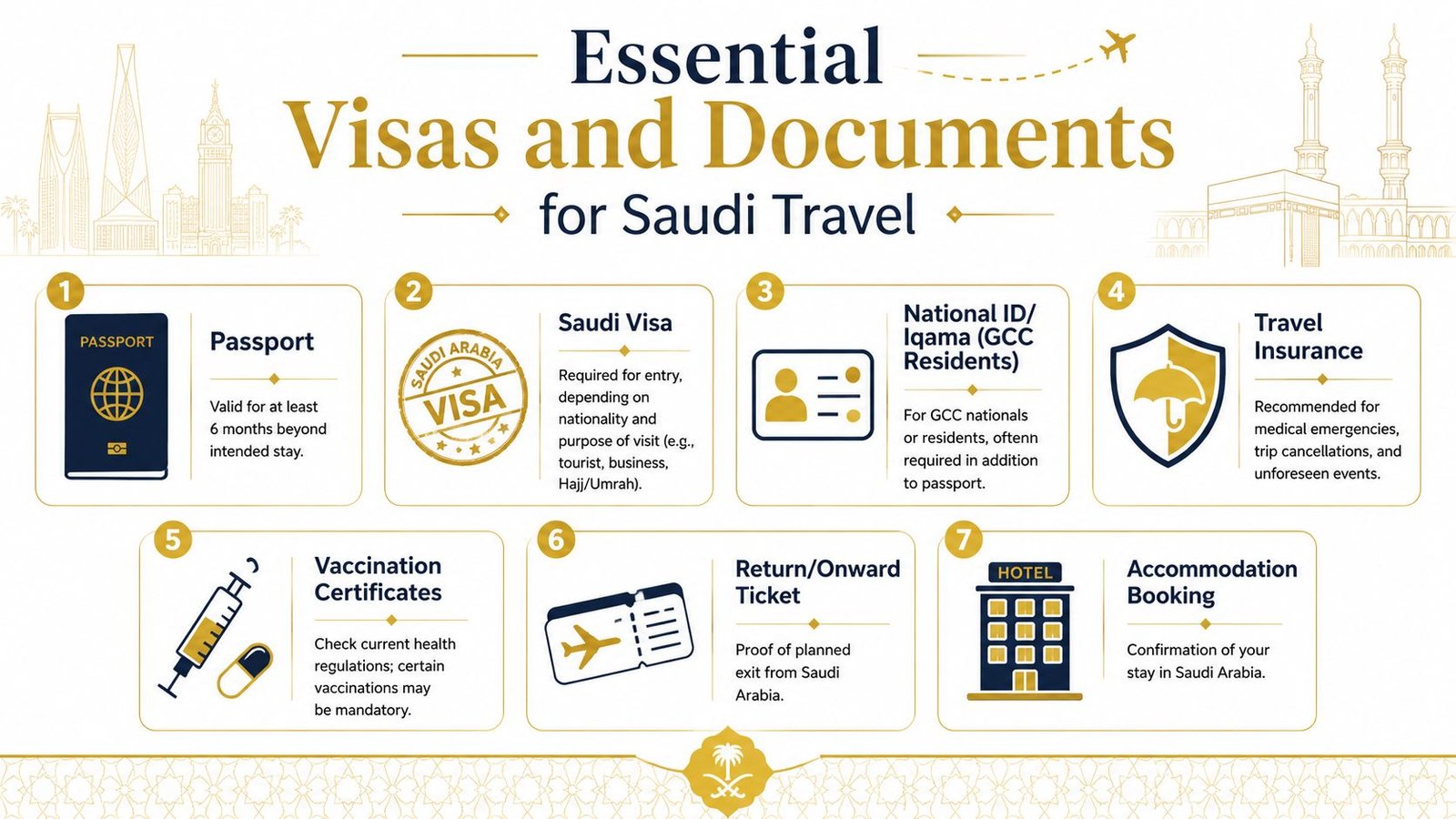
A Dubai to Saudi road trip can unravel at the checkpoint even when the vehicle is perfect and the route is clear. The usual cause is paperwork. A visa category does not match the traveller’s profile, an insurance certificate does not extend into Saudi Arabia, or a driver reaches the counter without the original vehicle documents in hand.
Book a VIP Dubai to Saudi Private Transfer
Travel from Dubai to Saudi Arabia with a professional chauffeur and premium private vehicle. NSB Luxury Transport provides comfortable door-to-door transfers, flexible departure times, experienced drivers, and reliable cross-border travel for business trips, family visits, and VIP journeys.
View Dubai to Saudi Service Enquire on WhatsAppFor VIP travel, document control is part of the service, not an afterthought. A professional chauffeur operator checks passenger eligibility, vehicle paperwork, and cross-border insurance before dispatch. That reduces the chance of being turned back after hours on the road, which is far more expensive than any fuel saving.
Core personal documents
Start with the traveller, not the car.
- Passport validity: Your passport must have at least six months’ validity from the arrival date for road entry into Saudi Arabia (passport validity requirement for road travel).
- UAE visa status: Travellers on a UAE visa should also confirm that their UAE residency or entry status remains valid for the trip. Border officers can question short remaining validity even when the passport itself is in order.
- Saudi visa: Where a tourist e-visa applies, it is valid for 365 days from issue, allows multiple entries, and limits total stay to 90 cumulative days within that validity period (Saudi entry requirements guidance).
- Health insurance: Saudi entry requirements can include medical cover for the period of stay, so the traveller should confirm the policy terms before departure rather than relying on assumptions at the border.
Corporate travellers should also match the visa type to the actual purpose of travel. A meeting, site visit, family stop, or religious journey can trigger different scrutiny. That is one reason premium clients use a cross-border chauffeur service. The operator can confirm the travel file before the car leaves Dubai.
Vehicle and insurance requirements
The vehicle file needs the same level of attention.
- Vehicle registration: The original Mulkiya should be available for inspection at the border.
- Driving credentials: For a self-drive trip, the driver must carry a valid UAE driving licence and supporting identification. If the driver is not the registered owner, extra ownership or authorization documents may be requested.
- Saudi-covering motor insurance: The policy must clearly cover Saudi Arabia. For luxury and company vehicles, this often needs to be arranged in advance rather than handled casually on arrival.
- Operator documentation: With a professional chauffeur service, the transport company should already hold the commercial and vehicle papers needed for cross-border movement. That removes a common point of failure for private travellers.
This is one of the clearest trade-offs on the route. A private driver may appear cheaper at first glance, but the passenger carries the administrative risk. With a professional service, that risk sits with a company that handles these crossings regularly and knows which missing paper can stop the trip completely.
For travellers arriving by air and continuing straight to Saudi by road, it helps to align flight timing, baggage handling, and border documents before pickup. That is easier to control when the journey begins with pre-arranged Dubai Airport luxury car arrangements.
Missing insurance or incomplete vehicle papers can stop the journey at the border, regardless of the car class or the passenger’s schedule.
Why VIPs Choose a Dubai to Saudi Chauffeur Service
A CEO leaves Dubai after a full day of meetings, needs to stay reachable on the road, and has a fixed arrival window in Saudi Arabia the next morning. On this route, the main question is not whether a private car can make the journey. It is whether the traveller arrives rested, on schedule, and without a border delay caused by a document check the passenger should never have to manage personally.
Self-drive cost estimates often focus on fuel alone. That misses the expensive part of the decision. Long-distance road time, attention at the border, wear on a premium vehicle, insurance exposure, and the value of arriving in working condition matter far more than pump price on a cross-border executive trip.
For senior travellers, the cabin is part of the workday. A professional chauffeur turns the trip into protected time instead of dead time. Calls can continue. Presentations can be reviewed. Rest is possible. That matters if the next stop is a boardroom, a family office, a private residence, or an airport transfer on a tight schedule.
The operational trade-off is simple. Self-driving gives control of the wheel. A chauffeur service gives control of the day.
What VIP clients are actually paying for
The strongest chauffeur services are priced around risk, vehicle standard, and execution quality, not just mileage. A premium sedan on this route carries higher running costs than a standard car, and the service model includes more than the vehicle itself.
Clients are usually paying for:
- Driver stamina and focus: The passenger avoids the fatigue that builds over a long interstate run.
- Border handling experience: An experienced cross-border operator knows how to present the trip, the passengers, and the vehicle paperwork in a way that reduces avoidable friction.
- Schedule protection: Delays are easier to absorb when the journey is planned by a team that regularly handles departure timing, rest windows, and route coordination.
- Cabin privacy and comfort: Quiet space, charging access, climate control, and a composed ride matter more on this route than they do on a short city transfer.
- Vehicle suitability: Premium transport works best when luggage space, passenger count, and comfort expectations are matched correctly from the start.
This is why frequent international travellers often stay with a trusted luxury car service in Dubai instead of treating a Dubai to Saudi transfer like a simple road trip. They are buying reliability, discretion, and fewer failure points.
The hidden cost of doing it yourself
A self-drive plan can look cheaper on paper, especially if the comparison starts and ends with fuel. That comparison is incomplete. It does not account for concentration over a long route, the chance of a border-side document issue slowing the trip, or the business cost of arriving tired and losing half the next day to recovery.
I have seen this trade-off many times. Travellers who are comfortable paying for premium hotels and business-class flights sometimes underestimate road fatigue because the car feels familiar. By the time they reach Saudi, the problem is no longer transport cost. It is reduced performance, a delayed meeting, or a schedule that has already started slipping.
VIP road travel works best when the passenger can stay focused on the reason for the trip, not the mechanics of getting across the border.
How to Book Your Cross-Border Chauffeur
The booking process should be simple, but the preparation behind it needs to be exact. Cross-border transport works best when the traveller provides the right details early, especially for Saudi destinations such as Riyadh, airport gateways, hotels, business districts, or private residences.
What to prepare before confirming
A serious booking starts with the basics, then moves to the details that determine vehicle suitability and compliance.
- Travel profile: Number of passengers, luggage volume, and whether the trip is one-way or return.
- Route details: Exact pickup location in Dubai, such as Business Bay, Palm Jumeirah, Downtown Dubai, Dubai Marina, JBR, or DXB Airport, plus the final destination in Saudi Arabia.
- Traveller status: Nationality, residency status, and whether any passenger needs extra document review before departure.
- Purpose of travel: Business meeting, family visit, event transport, airport transfer, or religious travel.
What a smooth booking process looks like
The best operators confirm more than time and vehicle class. They verify cross-border readiness, passenger requirements, and whether the chosen vehicle type matches the luggage and comfort brief. That’s particularly important for families, executive teams, and VIP guests who expect privacy and a quiet cabin.
Travellers who already use a chauffeur in Dubai will find the process familiar, but the Saudi element adds another layer. The booking should cover identity checks, routing expectations, and document readiness before the day of departure.
A good booking conversation is specific. It should answer where you’ll be collected, what the vehicle should accommodate, what documents must be in hand, and who to contact if the itinerary changes.
Your Dubai to Saudi Travel Questions Answered
A Dubai to Saudi road transfer works well for travellers who need privacy, schedule control, and direct arrival at a hotel, office, residence, or event venue. For executives in particular, a key advantage is not only avoiding airport queues. It is arriving rested, with documents checked in advance and a driver who already knows how to handle the border process.
Is Dubai to Saudi by road practical for business travel?
Yes, if the priority is door-to-door travel with fewer handoffs. A professional chauffeur service suits executives who need to work en route, take confidential calls, protect presentation materials, or keep a tight schedule without relying on flight timings and airport transfers.
The trade-off is simple. Road travel takes longer than flying in pure transit terms, but it can save time around check-in, baggage collection, airport transfers, and last-minute itinerary changes.
How long should I realistically allow for the full journey?
Allow for the full driving time plus border processing, rest stops, and any change in traffic conditions. Border clearance is the variable that matters most. Some crossings move efficiently. Others take longer because of document review, vehicle checks, or peak travel periods.
For important meetings, avoid planning on a razor-thin schedule. The safer approach is to build in margin and treat the border as a live operational step, not a fixed timestamp.
Is self-driving cheaper than a chauffeur?
It can appear cheaper if the comparison stops at fuel. That is not how experienced travellers assess this route.
A proper comparison includes fatigue over a long cross-border drive, the risk of document errors, time lost if entry questions arise, vehicle wear, insurance limitations, and the cost of arriving tired before a meeting, family event, or religious journey. For senior executives and VIP travellers, that lost readiness is often more expensive than the transport itself.
Why do premium chauffeur prices differ from ordinary car costs?
Premium cross-border pricing reflects more than the vehicle. It includes chauffeur time, long-distance operating hours, route planning, border familiarity, commercial insurance structure, vehicle preparation, and the level of comfort expected on a full-day regional transfer.
Fuel is only one line item. On a route of this length, a luxury sedan or SUV carries meaningful running costs before driver time and service standards are even counted. That is why a professional quote should be judged on reliability, legal readiness, and passenger condition on arrival, not against a basic private car calculation.
Can this route work for Umrah, weddings, or family groups?
Yes, and these trips often benefit most from professional handling. Family groups usually need more luggage planning and more cabin space. Wedding and event transport needs punctuality and presentation. Umrah travel often depends on having the paperwork, passenger details, and route timing confirmed before departure.
The route is workable. The preparation has to match the purpose of travel.
What documents cause the most last-minute problems?
The usual problems are passport validity, visa status, vehicle papers, and insurance acceptance for cross-border travel. Travellers also run into difficulty when they assume a document that worked on a previous trip will still be accepted without checking current requirements.
In practice, last-minute issues are rarely random. They usually come from incomplete review before the car leaves Dubai.
Is a luxury SUV or executive van better than a sedan?
That depends on who is travelling and how they need to arrive. A sedan suits solo executives, couples, and travellers carrying limited luggage who want a quiet cabin and a formal executive feel. A luxury SUV gives more luggage room and a higher seating position, which many families prefer on longer road journeys. An executive van is the better choice for larger family groups, wedding parties, support staff, or travellers who need space to move, store multiple bags, or travel together without splitting the party across vehicles.
The best vehicle is the one that fits the passenger count, baggage load, and arrival standard expected at the destination.
Book your ride with NSB Luxury Transport, available 24/7 across Dubai and the UAE. Whether you need airport transfers, chauffeur services, corporate transportation, full-day car hire, or cross-border travel to Oman and Saudi Arabia, our professional chauffeurs and luxury fleet are ready to assist. Book online at nsbluxurytransport.com or contact us via WhatsApp.
Conclusion
For travellers planning Dubai to Saudi transport, the right choice depends on more than surface cost. Road travel can be highly effective, but only when the route, documentation, insurance, and border requirements are handled properly. Business executives, VIPs, families, and event travellers usually benefit most from solutions that reduce fatigue, protect time, and keep the day predictable.
That’s why professional cross-border travel has lasting value. It turns a long regional transfer into a managed journey with fewer risks and better comfort. If your schedule matters, your documents need to be right, and your arrival condition counts, Dubai to Saudi transport should be planned with the same care as the meeting or event waiting at the other end.
Book Your Chauffeur Service
Fast booking support for airport transfers, chauffeur service, and private car with driver in Dubai.
WhatsApp: +971 525 579 638
Email: booking@nsbluxurytransport.com
Website: www.nsbluxurytransport.com