
If you’re planning Dubai to Makkah, you’re not really choosing a route, you’re choosing how much friction you want in the trip. A family leaving from Dubai Marina or Deira usually starts with the same question, should we drive all the way, fly and transfer, or book a chauffeur who can handle the long-haul logistics without turning the journey into a stress test.
The honest answer is simple, Dubai to Makkah is a long trip either way. By road, the corridor is roughly 1,835–1,855 km, while the air distance sits around 1,617–1,637 km depending on the estimator you use, with Rome2Rio listing 1,855 km by driving and an estimated 19 h 39 min drive time, and Mapcrow showing 1,616.93 km in a straight line Rome2Rio route data. Makkah also has no commercial airport, so even air travellers are really planning a flight-plus-ground-transfer journey, not a direct arrival into the city DXB to Makkah route data.
The point of this guide is practical. If you care about luggage space, family comfort, prayer stops, border paperwork, and whether the journey feels organised or chaotic, you’ll make a better decision here than by just looking at distance alone.
Planning Your Journey from Dubai to Makkah?
NSB Tourism can help you plan a smooth and comfortable journey from Dubai to Makkah. Whether you need Umrah travel assistance, Saudi visa support, hotel bookings, or luxury chauffeur transportation, our experienced team is ready to assist you every step of the way.
Table of Contents
- Understanding the Dubai to Makkah Journey
- Driving Versus Flying A Real Comparison
- Border Crossing Requirements and Documentation
- The Air-Plus-Ground Alternative Explained
- Why Professional Chauffeur Services Simplify the Journey
- Planning Your Trip A Practical Checklist
- Making Your Booking and Final Preparations
Understanding the Dubai to Makkah Journey
A father in Business Bay, a mother in JBR, and three kids in the back seat do not need romance. They need a realistic plan. That is what Dubai to Makkah demands, because this is not a quick UAE city hop, it’s a serious cross-border pilgrimage journey where the difference between a smooth departure and a miserable one often comes down to how well you understand distance, timing, and the shape of the route.
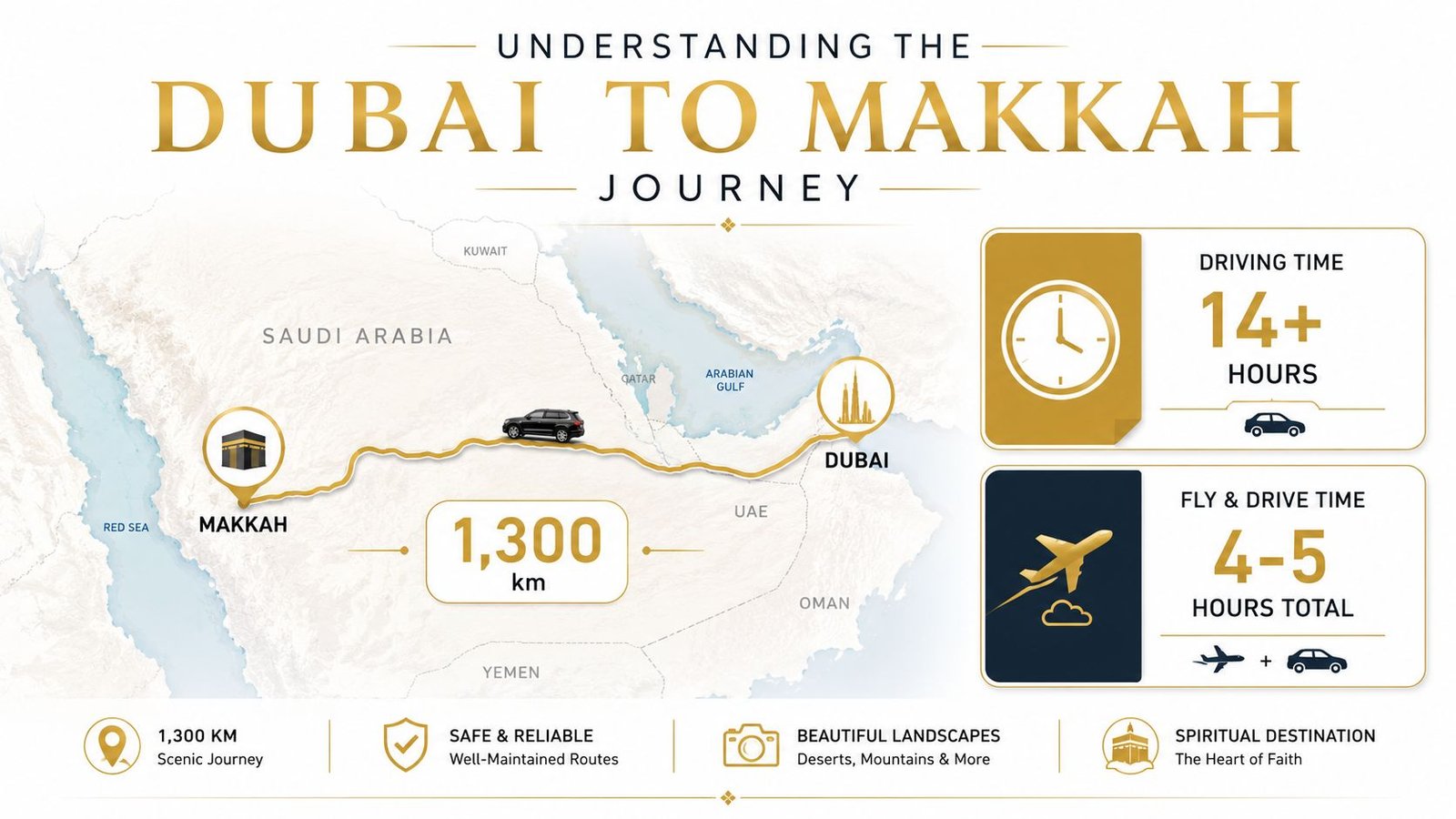
The road journey is long enough to change the whole decision. Rome2Rio lists a driving distance of 1,855 km and an estimated 19 h 39 min drive time, while other route tools place the aerial distance around 1,618–1,637 km and the road distance around 1,834–1,849 km Rome2Rio route data, route comparison data. That spread matters because a map pin does not tell you how long the border will take, how often you’ll stop, or how the road feels once fatigue sets in.
Practical rule: if a trip crosses a border, assume the map is only the starting point. Real travel time starts after you factor in stops, compliance checks, and the pace of the slowest traveller.
The other fixed reality is Makkah itself. Since Makkah has no commercial airport, every air-based plan ends with a transfer from a nearby gateway such as Jeddah or Taif DXB to Makkah route data. That makes this corridor different from many regional trips from Dubai, because you’re not deciding between a direct flight and a direct drive. You’re deciding between a very long drive, or a multi-leg journey that still requires a road segment at the end.
For travellers in Downtown Dubai, Palm Jumeirah, or Abu Dhabi, the key question is not distance alone. It’s whether you want the least number of moving parts, or the most comfort once the moving parts begin. For a cross-border route like this, that choice shapes everything.
Driving Versus Flying A Real Comparison
Driving sounds simple until you factor in the border. Flying sounds faster until you remember the final road transfer into Makkah. The decision is which route gives your group less friction, better luggage control, and fewer problems once the trip starts to wear people down.
What driving really feels like
A direct road trip from Dubai to Makkah is a long overland run. Rome2Rio’s 19 h 39 min estimate is a useful baseline, but family travel usually takes longer once you add rest stops, border processing, and traffic. If you are travelling with children, elderly parents, extra bags, or prayer gear, driving gives you control. You can stop when you need to, keep your luggage with you, and keep everyone in one vehicle.
That control matters more than people admit. It reduces the stress of repacking, waiting for separate pickups, and splitting the group across different vehicles. For some travellers, that is the right trade-off. For others, the sheer length of the drive makes it a poor fit, no matter how convenient the luggage situation looks on paper.
What flying actually solves
Flying removes the fatigue of the long road leg, but it does not remove the need for ground transport. The Dubai Airport to Makkah route still ends with a flight-plus-taxi or flight-plus-car transfer, and Rome2Rio lists the fastest option at about 4 hours 16 minutes DXB to Makkah route data. That time savings is real, but it only works if the airport leg, baggage handling, and pickup are all organised properly.
Price is a separate question. Skyscanner’s Dubai-to-Mecca search shows one-way fares starting from ₹2,422, which tells you the fare floor shifts depending on timing and routing Skyscanner fare data. If you want a broader overland comparison for another Saudi route, the Dubai to Riyadh bus comparison shows how road travel changes once comfort, stops, and border handling enter the equation.
| Factor | Driving | Flying + Ground Transfer |
|---|---|---|
| Time commitment | Long-haul, usually a full-day-plus journey | Shorter overall, but still includes airport and transfer time |
| Luggage flexibility | High | Moderate to high, depending on airline and transfer choice |
| Family comfort | Strong if the vehicle is suitable | Strong if the transfer is well coordinated |
| Border friction | Direct and unavoidable | Reduced, because most of the distance is covered in the air |
| Prayer stop flexibility | High | Lower once the trip is broken into fixed legs |
| Planning complexity | Moderate to high | Higher, because timing has to line up |
The right choice depends on the problem you want to solve. If you want full luggage control and can handle the border, driving works. If you want to cut the hardest part of the journey, flying plus a ground transfer usually makes more sense.
Do not treat this as a simple cheap-versus-expensive call. It is a comfort-and-fail-safes decision. Families care about whether children can sleep, whether elderly travellers can stretch, and whether prayer and meal stops are built into the day. Those practical details matter more than shaving a small amount off the headline price.
My advice: choose the option that protects the weakest part of the group, not the strongest traveller’s preference.
Border Crossing Requirements and Documentation
The border is where weak plans break. People spend weeks comparing mileage and fuel, then stall at the checkpoint because they treated paperwork like an afterthought. For Dubai to Makkah by road, the border process sits at the center of the trip, and it decides whether the journey feels controlled or chaotic.
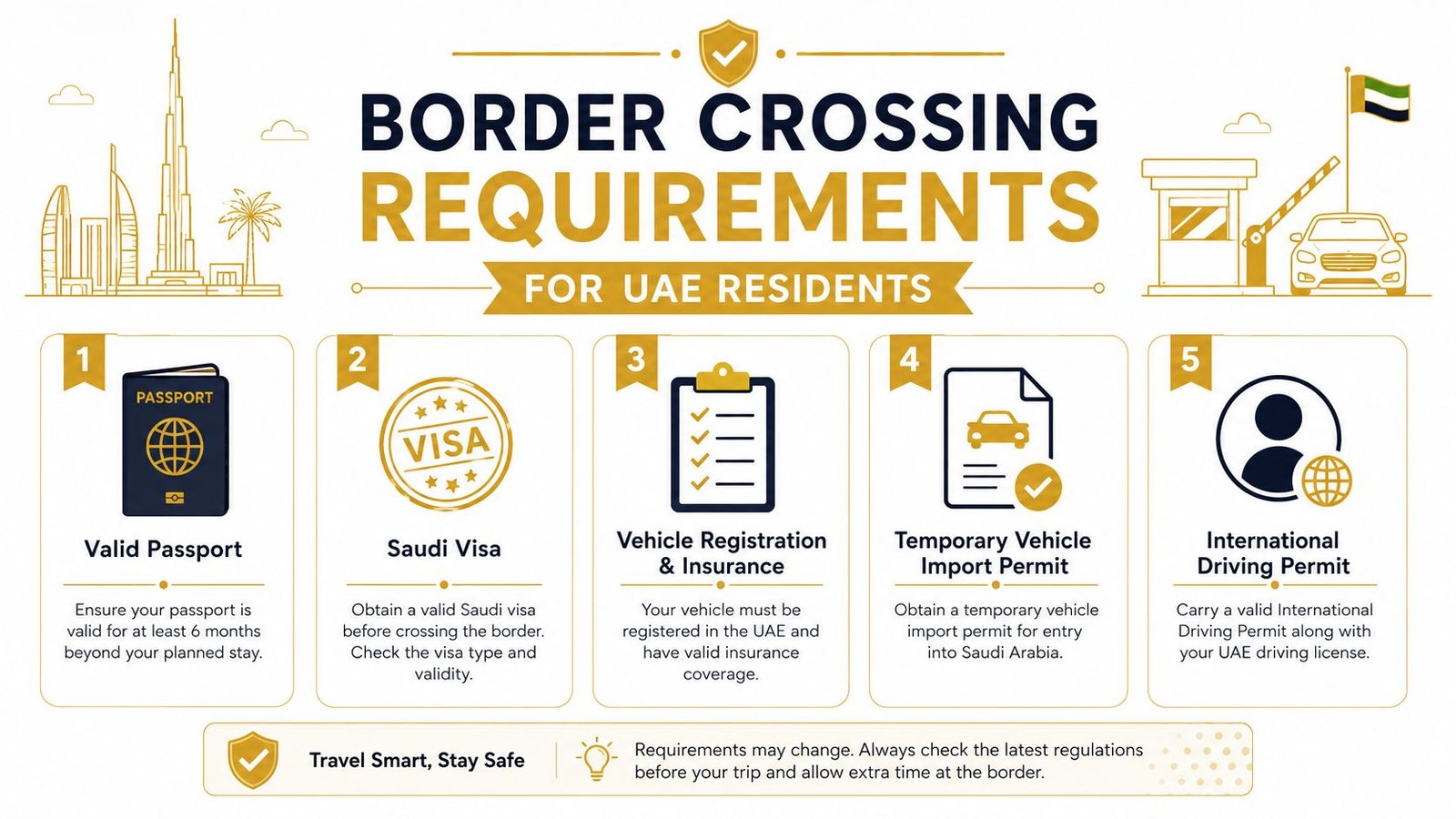
A UAE road-travel guide says residents driving for Umrah usually need an Umrah visa or an eligible Saudi tourist eVisa, Saudi-valid car insurance, passport and vehicle documents, and the trip commonly runs through the Al Ghuwaifat/Al Batha border UAE road-travel guidance. If any one of those items is missing or mismatched, the delay can become expensive very quickly.
What to organise before you leave
Check the driver first, then the vehicle. If you are using a private car, confirm the countries covered by your licence through this guide on UAE driving license valid countries, then verify that the rest of your documents line up with the trip.
A traveller forum discussion also mentions items such as a UAE ID, sponsor NOC, vaccination card, vehicle paperwork, and in some cases a Carnet Du Passage, but that information is scattered rather than presented as a clean official checklist border discussion. Treat that as a warning, not as a final answer. The standard is simple, every document tied to identity, eligibility, and vehicle permission must be current, legible, and consistent with the traveller crossing the border.
Common mistakes that waste time
- Assuming one visa fits every traveller: family members may not all fall under the same travel category, so confirm each passport’s status separately.
- Ignoring insurance wording: car insurance must be valid for Saudi Arabia, not just the UAE.
- Leaving vehicle documents in another bag: border staff can ask for them at the wrong moment.
- Treating the border like a fuel stop: it is a compliance checkpoint, not just a queue.
Cross-border travel rewards the organised traveller and punishes the casual one.
For drivers in Dubai, Al Ghuwaifat/Al Batha is the checkpoint to plan around, not the place to improvise. If you are booking a private car or chauffeur service, ask upfront what papers they need from you, what they carry on their side, and what happens if a document is missing at the border. That question saves more stress than any brochure ever will.
The Air-Plus-Ground Alternative Explained
The smartest travellers on this route often do not choose between road and air in the abstract. They choose air plus ground, because that cuts the longest and most tiring part without giving up control at the destination.
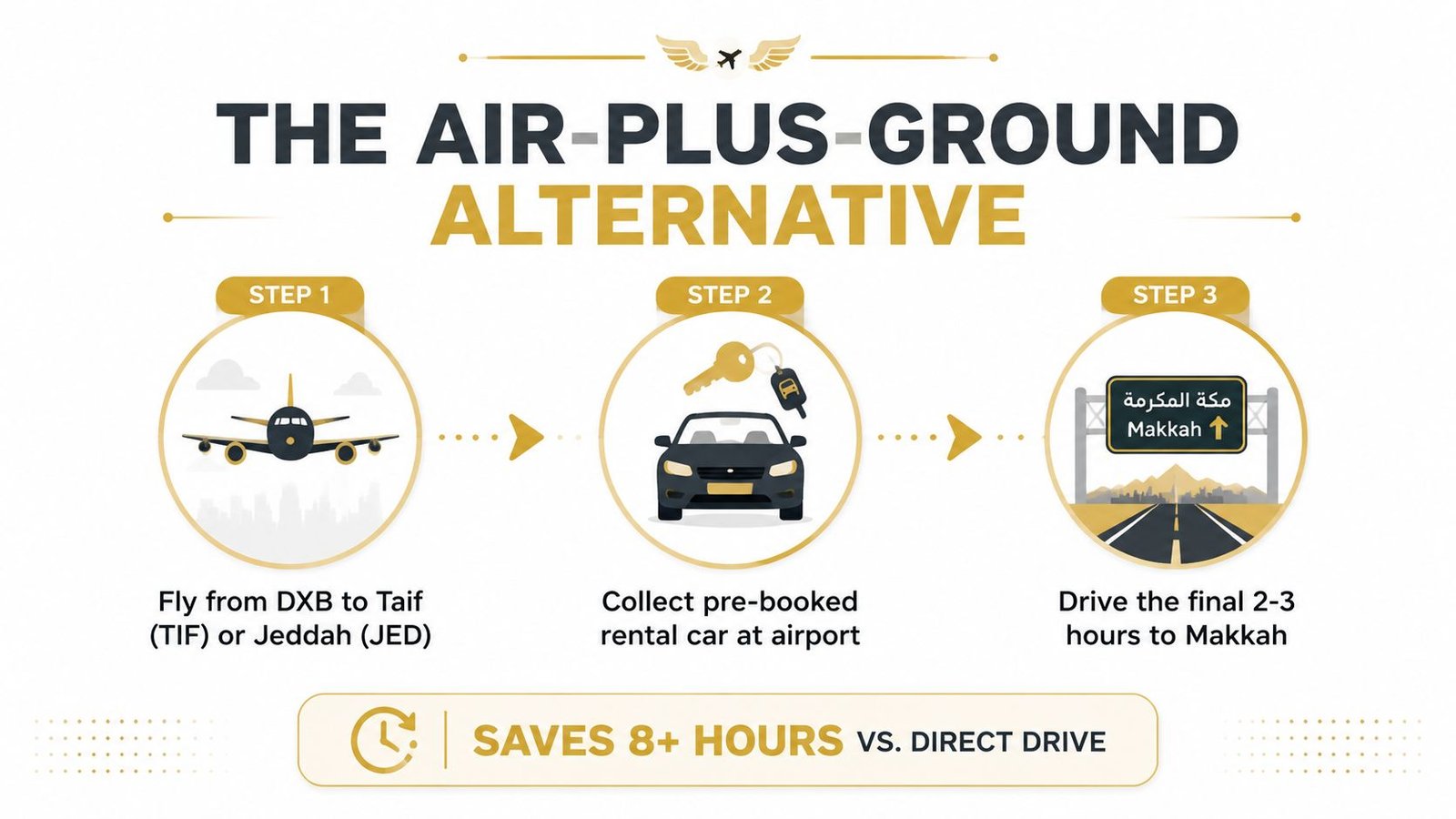
The key benefit is obvious. You fly from Dubai to a Saudi gateway such as Taif or Jeddah, then finish by car. One route guide claims the Dubai-to-Mecca trip can be done in about 52 minutes if you combine a flight to Taif with a drive, while another route estimate says a fly-and-train combination can cost roughly $110 to $220 and take 7h 23m route guide data. Those figures are not the same itinerary, but they point to the same thing, the decision is multimodal timing, not a pure road-versus-air comparison.
Why this option works for UAE travellers
This approach reduces the friction that families dislike most. You avoid the mental load of a multi-day drive, but you still keep enough luggage flexibility for a pilgrimage trip, which often means more baggage than a normal city break. It also makes coordination easier if you are travelling with older relatives who need shorter ground segments and fewer road hours.
How to make it work properly
Book the flight around your ground-transfer availability, not the other way around. If your airport arrival time is loose, your transfer becomes the weak link. If you pre-arrange the car or chauffeur ahead of time, you get a cleaner handover and avoid standing outside a terminal with tired children and bags.
The road side still matters after the flight. Fuel stops, rest infrastructure, and Saudi-side highway conditions all influence the last leg, so I would not call this a casual taxi ride. It is a planned transfer, and it should be treated that way.
For travellers who want an organised cross-border handoff, I’d also look at NSB Luxury Transport’s Dubai to Saudi Arabia route page as a service reference point rather than a generic taxi substitute. The main advantage of this model is that it recognises the trip as a sequence, not a single ride.
Why Professional Chauffeur Services Simplify the Journey
A good chauffeur service earns its place on Dubai to Makkah when it removes decisions, not when it adds promises. The value is in structure. You get a vehicle that suits the group, a driver who understands long-haul travel, and a provider that can coordinate the departure around the route you’ve chosen.
What a chauffeur actually solves
For this corridor, the biggest pain points are luggage, comfort, timing, and border coordination. A private driver can keep the trip organised around prayer stops, meal breaks, and family needs without turning every stop into a negotiation. That matters if you’re travelling with children, elderly parents, or guests who do not want the uncertainty of ad hoc road-side arrangements.
Vehicle choice matters too. A luxury sedan works for a small executive party, but a larger SUV or van is the better fit once the luggage count rises. NSB Luxury Transport’s luxury car service in Dubai sits in the middle of that conversation because it represents the kind of private, pre-arranged ground transport travellers often need when they want a calmer cross-border experience.
Where the service value shows up
- Fixed coordination: You are not trying to find a car after landing or at the border.
- Comfort for long hauls: Better seating, better spacing, and less stress.
- Luggage handling: More practical than squeezing bags into inconsistent ride-hailing options.
- Trip discipline: The driver works to the plan instead of improvising the route.
- Discretion and privacy: Useful for families and business travellers alike.
The strongest argument for a chauffeur here is not luxury for its own sake. It’s reliability. A trip this long punishes small mistakes, and a professional driver reduces the odds of those mistakes becoming your problem. That is especially important if your group is coming from Dubai Marina, DIFC, or Palm Jumeirah, where departure timing is already tight and the handoff from home to highway needs to be clean.
Planning Your Trip A Practical Checklist
Good planning for Dubai to Makkah starts earlier than most travellers think. The people who arrive calm are usually the ones who confirmed their route, documentation, and transport option long before the departure date.
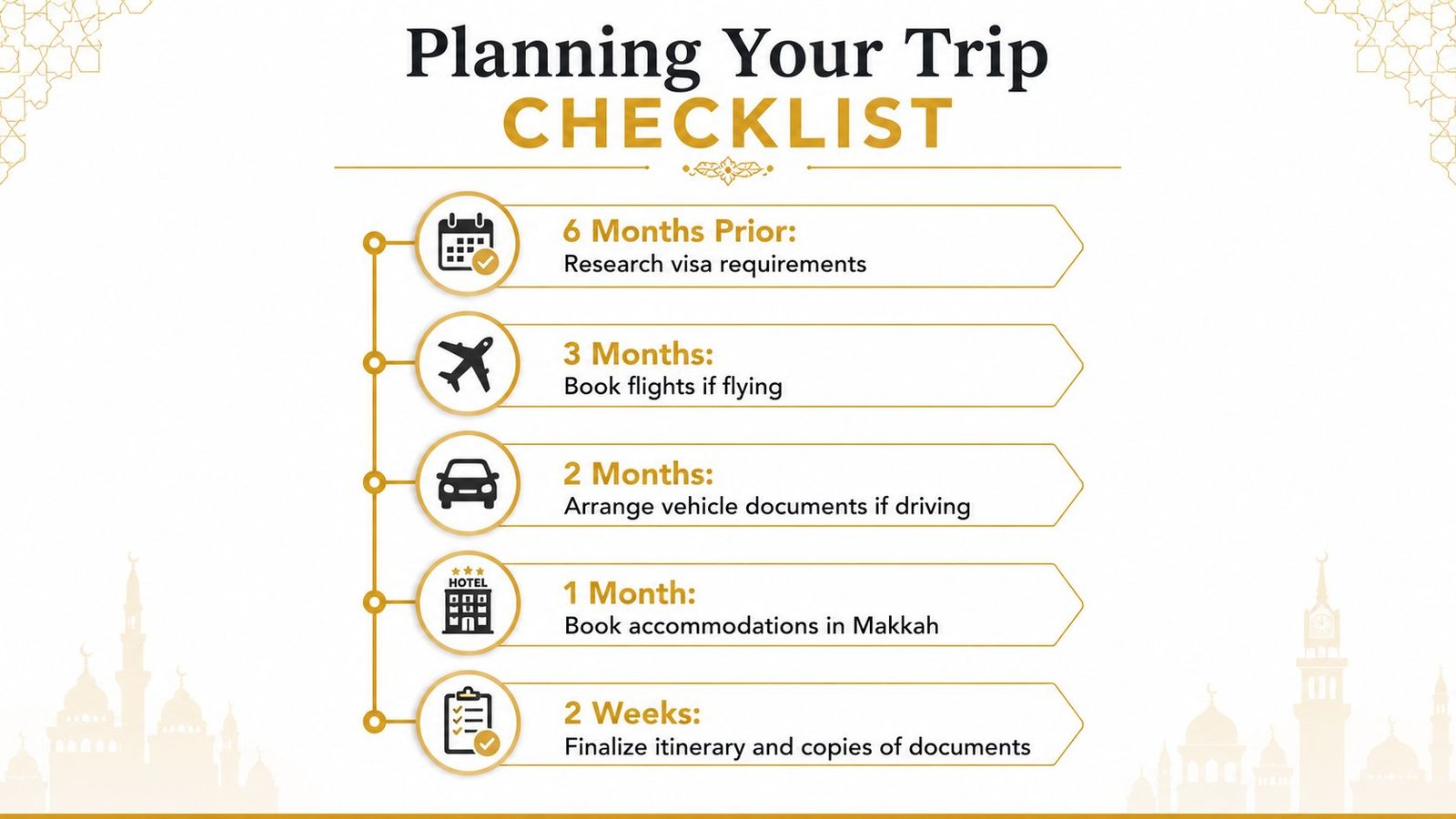
A sensible checklist is simple.
- 6 months prior: Research visa rules and decide whether your group will drive or fly.
- 3 months prior: If you’re flying, lock in the itinerary once the gateway airport makes sense.
- 2 months prior: If you’re driving, confirm vehicle documents, insurance, and border-ready paperwork.
- 1 month prior: Secure accommodation in Makkah so your arrival window is not hanging loose.
- 2 weeks prior: Print and pack document copies, and finalise your transfer plan.
That planning sequence is especially important if you are coordinating more than one traveller. Families often wait too long to settle who rides where, who carries which documents, and whether luggage will go in the main car or a second vehicle. Those questions should be answered before departure day, not in the driveway.
Trip type changes the checklist
Solo business travellers usually care most about speed and predictability. Families need comfort and space. Larger groups need someone to own the coordination, because the risk is not the drive itself, it’s the handoff between airport, hotel, and pilgrimage schedule.
If you are booking through a chauffeur provider, ask how they handle departure timing, route changes, and traveller briefings. For travellers comparing airport coordination points in the UAE, this Dubai airport guide is a useful reminder that your ground plan should match the airport you use, not the one you assumed at the start.
Bottom line: your trip is only as smooth as your paperwork and pickup plan.
Making Your Booking and Final Preparations
The last step is not finding a vehicle, it’s confirming the details that prevent mistakes. For a long Dubai to Makkah trip, ask your transport provider exactly what documents they need from each passenger, what they expect at the border, and how they manage delays if the queue is slow. If you are flying, confirm who collects you at the airport and what happens if your flight lands later than planned.
Pack for the trip as if comfort will matter, because it will. Keep passports, visas, IDs, vehicle papers, chargers, water, medication, and a small prayer kit within reach, not buried deep in luggage. If your group includes children or older relatives, distribute essentials so one lost bag doesn’t interrupt the whole day.
Booking early helps, but booking clearly helps more. A vague arrangement gives you a vague trip. A defined plan gives you better control over departure time, rest stops, baggage handling, and arrival in Makkah.
If you want a private, organised option for Dubai to Makkah, NSB Luxury Transport can help with chauffeur-driven cross-border travel, airport transfers, and long-distance ground coordination across the UAE and Saudi routes. Visit NSB Luxury Transport to arrange the vehicle and schedule that fit your Umrah journey, and make the trip easier before you ever leave Dubai.
Book Your Chauffeur Service
Fast booking support for airport transfers, chauffeur service, and private car with driver in Dubai.
WhatsApp: +971 525 579 638
Email: booking@nsbluxurytransport.com
Website: www.nsbluxurytransport.com