
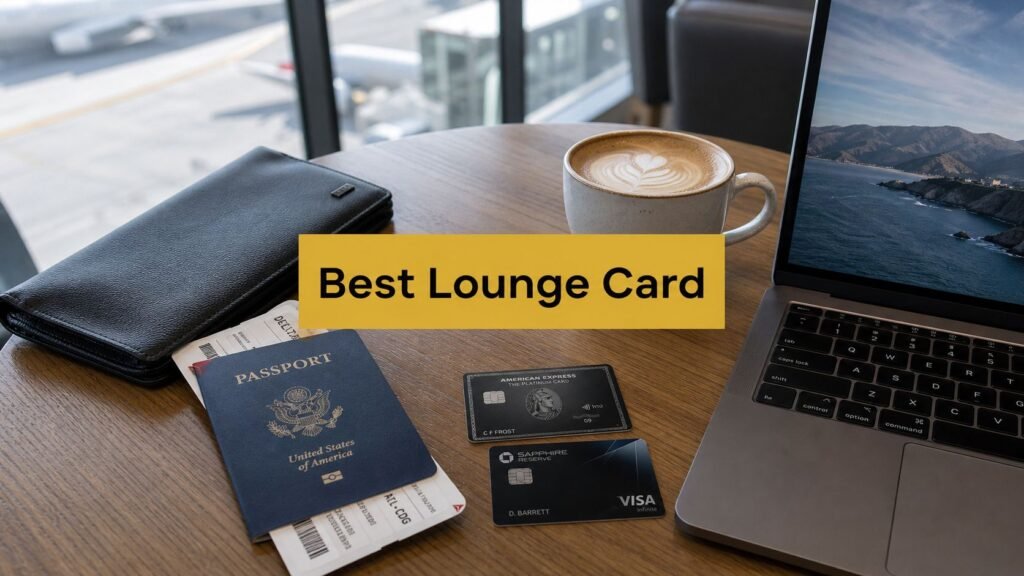
You're at DXB after a long-haul arrival, the meeting is close, and the question isn't whether you can get into a lounge. It's which best card for lounge access fits the way you travel, especially if your trips run through Dubai, Abu Dhabi, and other GCC hubs. For luxury travellers, the right answer usually comes down to network breadth, guest policy, and the effective cost per trip, not the headline card name alone. That matters even more in the UAE, where Dubai International Airport handled 86.9 million passengers in 2023 and traffic in 2024 exceeded 92 million, according to the airport authority and the lounge-access comparison cited below. A card that works across multiple lounge ecosystems can save time, reduce friction, and make short connections feel manageable. Dubai International passenger traffic context
Table of Contents
- The Best Card for Lounge Access Today
- Lounge Networks Behind Premium Cards
- Top Cards Compared for Lounge Access
- Matching Cards to Traveller Profiles
- True Cost of Lounge Access for Groups
- Alternatives Beyond Credit Card Lounges
- Recommendations for NSB Luxury Clients
- Frequently Asked Questions on Lounge Cards
The Best Card for Lounge Access Today
A business executive stepping off a night flight into Dubai rarely wants a brand story. They want a quiet seat, reliable WiFi, and enough lounge coverage to avoid gambling on one airline's footprint. That's why the best card for lounge access in the UAE usually isn't the card with the flashiest marketing, it's the one that gives the widest usable network across multiple airports and partner lounges. For travellers moving between Dubai, Abu Dhabi, and connecting hubs, that distinction matters more than a marginal difference in rewards categories.
Luxury chauffeur service in Dubai
What the shortlist has to answer
Three questions decide the winner. How many lounge networks does the card touch? Who can come in with you? What does access cost once fees and guest rules are included? Those questions matter because a broad lounge network can still be poor value if the guest policy is restrictive, while a narrower card can outperform it for couples or family travel.
Practical rule: In the UAE, pick the card that matches your route pattern first, then compare the fee.
That framework keeps the decision grounded. A solo executive who crosses airlines and alliances often values network reach. A couple or family who travels together often values guest flexibility more than pure lounge count.
Lounge Networks Behind Premium Cards
Premium cards usually plug into a small set of lounge ecosystems rather than one uniform global system. The most important names are Priority Pass, Centurion Lounges, Delta Sky Club, and airline-specific lounges. A single card may bundle several of these, which is why the card itself matters less than the access architecture behind it.
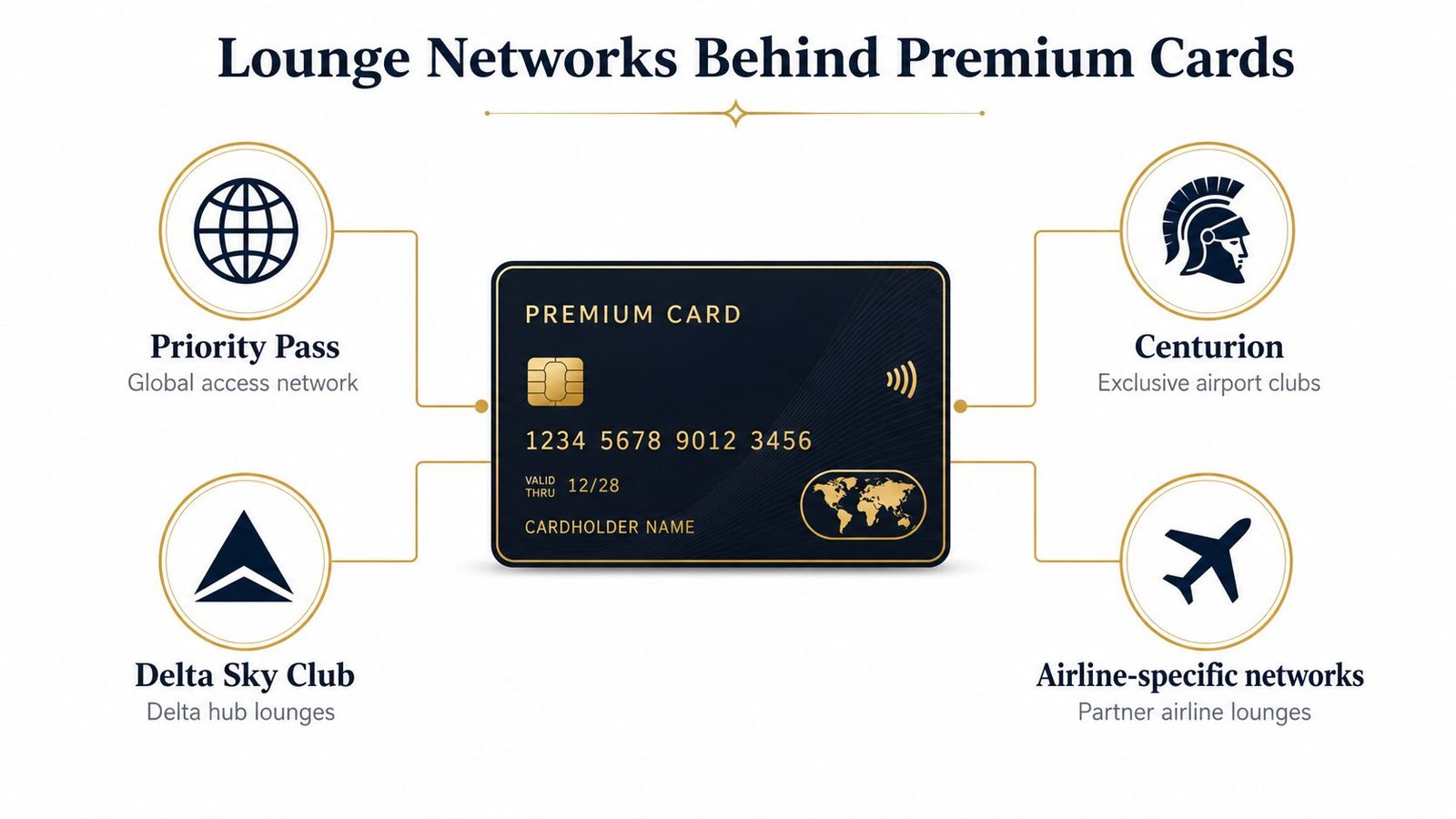
Why network breadth beats brand loyalty in transit hubs
For UAE-based travellers, breadth is the filter. Priority Pass alone covers more than 1,300 locations and standalone membership pricing ranges from $99 to $469 per year, which shows why included membership through a premium card can matter for frequent flyers. Priority Pass network size and pricing The point isn't that more lounges exist. The point is that itineraries through DXB, Abu Dhabi, and partner hubs often involve different operators, terminals, and alliance rules, so one-card, one-airline access can be too narrow.
How to read the lounge map
Think of the map in layers. Priority Pass gives broad multi-airport coverage. Centurion-style access adds premium branded lounges. Delta Sky Club access matters only when you're on eligible Delta flights. Airline-specific networks remain useful, but only when your itinerary lines up with that airline's rules. A premium card becomes valuable when it connects several of these layers at once, not when it leans on a single footprint.
The practical takeaway is simple. Before comparing fees, decide whether your travel life depends on coverage, guesting, or airline loyalty. In the Gulf, coverage usually wins first.
Top Cards Compared for Lounge Access
A lounge card only earns its place if it matches the way people move through airports. For a solo traveller, that often means the broadest network. For couples or a corporate pair, the guest policy can matter more than raw lounge count. In GCC transit, where itineraries often run through DXB, Abu Dhabi, and mixed-carrier connections, the card that works best is usually the one that reduces friction at the terminal door.
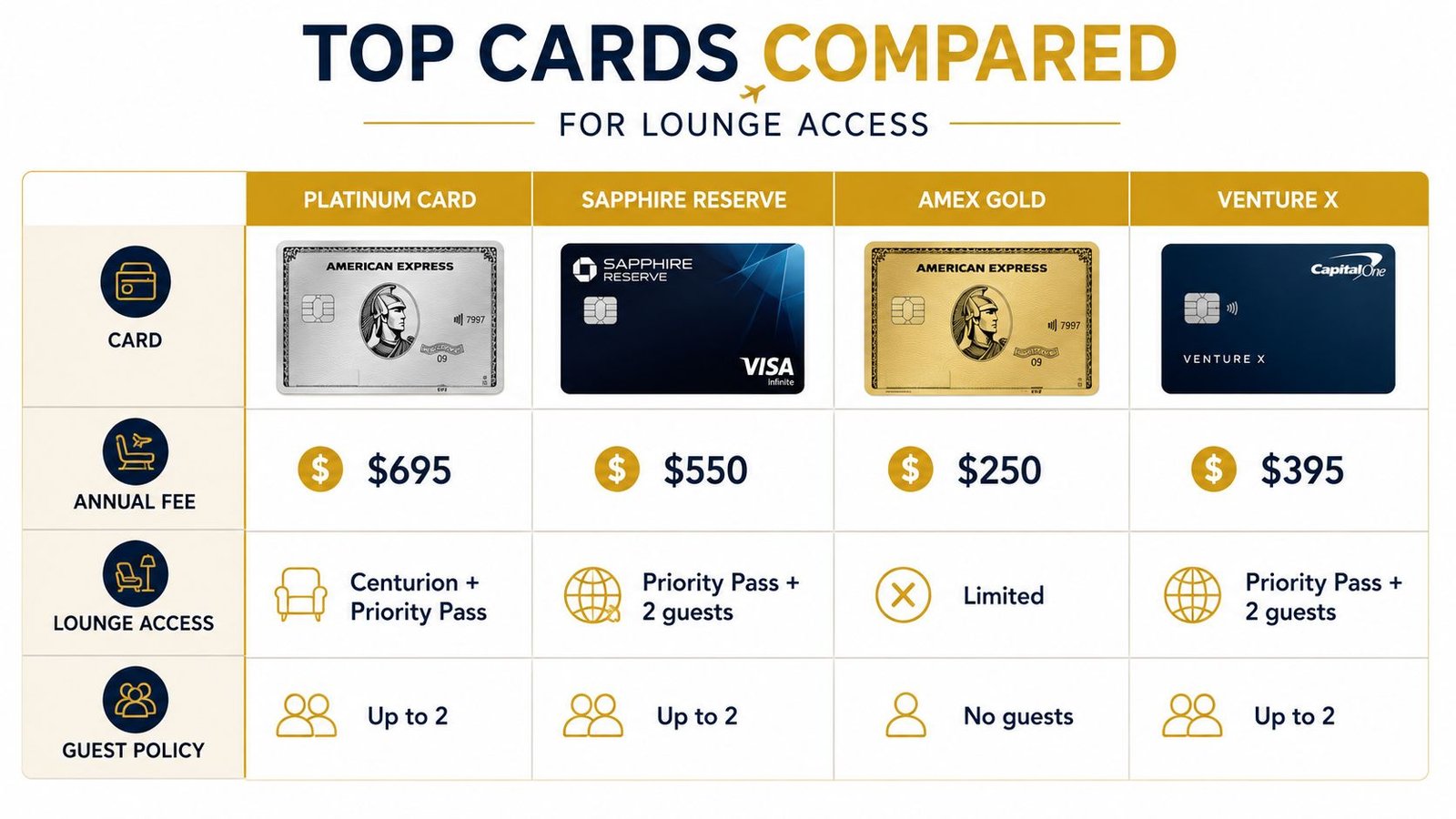
Premium Lounge Access Cards at a Glance
| Card | Lounge Networks | Guest Policy | Annual Fee |
|---|---|---|---|
| American Express Platinum Card | More than 1,550 lounges in the American Express Global Lounge Collection, including Centurion Lounges, Delta Sky Club access on eligible flights, Priority Pass Select membership, and partner lounges | Limited Delta Sky Club use to 10 visits per year unless $75,000 annual spend gives unlimited access | $895 |
| Chase Sapphire Reserve | Priority Pass and Sapphire Lounges | 2 free guests per visit at Priority Pass and Sapphire Lounges, with zero authorised-user fees | Not stated in the verified data |
| American Express Platinum Card, another review | Centurion, Delta Sky Clubs, Escape Lounges, Plaza Premium, and Priority Pass lounges | Delta Sky Club use limited as above | $695 in one review |
| Priority Pass standalone membership benchmark | More than 1,300 locations | Guest pricing depends on membership and lounge rules | $99 to $469 yearly |
The American Express Platinum Card has the widest mainstream footprint in the verified data, and that is the point that matters for frequent flyers who cross terminals, airlines, and alliance rules. It gives access to several lounge families at once, which reduces the chance of arriving at a hub with no useful option. American Express Platinum broader network and fee context
A separate source frames the same card as the strongest network choice in the market, which is consistent with its use case for travellers moving through busy transit hubs. American Express Platinum lounge network
Widest network versus best guest value
Widest network: American Express Platinum is the stronger single-card choice for travellers who want the broadest lounge reach.
Best guest value: Chase Sapphire Reserve is attractive for pairs because it allows 2 free guests per visit and has zero authorised-user fees.
That split matters because lounge access is not a single problem. A traveller who flies alone and changes airlines often may care most about having any workable lounge at the gate. A couple, or a business pair travelling together, may care more about avoiding guest charges on every trip. The better card is the one that matches the actual group pattern, not the one with the flashiest headline.
Why the fee gap matters
The annual fee changes the calculation quickly. A card with more lounge brands can still be poor value if the traveller barely uses lounges. A lower-fee card can make more sense if the main cost pressure comes from paying for extra guests rather than from missing access.
That is also where chauffeur-led airport transfers change the equation. If a traveller uses Abu Dhabi airport transfers, terminal time becomes part of the ground experience, so lounge access is judged less by prestige and more by how well it supports a scheduled arrival, a brief meeting, or a waiting spouse or colleague.
For lounge access, the better question is not which card sounds richest. It is which card creates the least friction for the route, the companion count, and the transfer pattern.
Matching Cards to Traveller Profiles
A solo executive moving between Dubai, Abu Dhabi, and long-haul hubs usually values certainty more than novelty. American Express Platinum fits that profile because it brings Centurion Lounges, Delta Sky Clubs, Escape Lounges, Plaza Premium, and Priority Pass lounges into one card. The trade-off is the annual fee, listed at $895 in the verified comparison, plus a tighter rule on Delta Sky Club use, which is limited to 10 visits per year unless $75,000 in annual spend opens unlimited access. American Express Platinum access and fee
Executive travel
For executives, the case for Amex Platinum is not status, it is less dead time. If a route crosses several lounge systems, the card lowers the chance of ending up in a terminal with no usable option. That matters most for travellers who already use premium ground transport and treat airport time as work time rather than waiting time.
A card like this suits people who value consistency across airports more than a single airline tie-up. In the GCC, where itineraries often include short transits, late schedule changes, and mixed carriers, broad access can be more useful than a narrow but familiar lounge network.
The best card for a road warrior is the one that fails least often.
Couples and corporate pairs
Chase Sapphire Reserve fits a different pattern. It works well for couples because it offers 2 free guests per visit at Priority Pass and Sapphire Lounges, with zero authorised-user fees. That reduces the surprise cost of bringing another traveller through the lounge, which matters when two people are consistently booking and transiting together. Guest policy comparison for couples
For paired business travel, guest policy often matters more than lounge brand count. A card that permits a companion without extra charges can create better per-trip value than a broader card that starts charging every time a second person appears at the desk.
Families and mixed groups
Families are harder to price. Lounge value rises when the whole party can enter together, but the cost also rises if the card charges per guest or if only the primary cardholder gets access. That is why the better choice for families is usually the card whose guest rules match the actual headcount, not the one with the loudest marketing.
Travel patterns in the UAE and wider GCC make that distinction sharper. A family using Abu Dhabi airport transfers may arrive early, wait together, and move as one group, so the right lounge card is the one that keeps everyone inside without turning each trip into a guest-fee calculation.
True Cost of Lounge Access for Groups
Group travel changes the maths. A lounge card that looks expensive for one person can make sense for a couple, while a card that looks broad can become poor value if every extra person triggers a fee. In some premium-card structures, guest access adds a meaningful cost unless spending thresholds are met, and that can wipe out much of the benefit for pairs or families. Group guest-cost insight
How to estimate value per trip
Start with the annual fee, then add the guest charges you expect across the year. If your spouse, assistant, or children travel with you often, the lounge benefit is no longer a simple yes-or-no perk. A higher-fee card with better guest rules can be the better deal than a lower-fee card that keeps adding charges every time another traveller joins you.
Chase Sapphire Reserve is useful here because the verified data highlights zero authorised-user fees and 2 free guests per visit. That structure reduces the hidden cost of bringing a companion into the lounge. American Express Platinum, by contrast, has a higher premium fee structure in the cited comparisons, so its value depends on how often you personally use the broader network.
Guest rules can matter more than lounge count. A card with modest network coverage but cleaner companion policies can produce better per-trip value than a card with more locations but frequent add-on costs.
The group-travel rule that matters most
If you travel with other adults often, do not evaluate lounge access as a solo perk. Treat it like a family or business hospitality cost. The best card is the one that keeps the per-trip cost predictable.
That logic already shapes how premium transport clients choose ground transfers. A chauffeur booking is often preferred because the cost is known in advance and the group stays together, rather than splitting into separate rides and separate bills. For UAE itineraries, even the transfer between cities can be priced as a single decision point, as shown in the route-specific guidance on taxi fare from Dubai to Abu Dhabi Airport.
Alternatives Beyond Credit Card Lounges
A premium card is not the only way to reach an airport lounge. If you fly only a few times a year, the annual fee can outweigh the benefit, especially for families and larger groups where guest charges can turn a simple lounge visit into a higher trip cost. In those cases, a day pass, a standalone Priority Pass membership, or a pay-per-use lounge can be the better financial fit.
When a day pass fits better
Day passes work well for long layovers and irregular travel patterns. The practical constraint is availability, since some lounges restrict entry based on capacity, so the better approach is to buy access only when the lounge can admit you. For occasional travellers, that keeps the decision tied to the specific trip instead of a long-term commitment.
When standalone Priority Pass works
Priority Pass is still a major benchmark because it covers more than 1,300 locations and standalone pricing runs from $99 to $469 per year. For solo international flyers who move across airlines and airports, that kind of network can be more practical than a card tied to one issuer. The trade-off is that the membership fee is separate from your credit card, so the value depends on how often you will use it. Priority Pass network and pricing
For groups, standalone membership can lose value quickly if guest charges stack up. A family trip or an executive travelling with support staff needs a per-trip comparison, not just a look at the headline membership price. If the lounge visit adds extra fees for each companion, the economics can shift fast.
A simple booking approach
- Check your route frequency. If you only fly a handful of times each year, annual card fees deserve close scrutiny.
- Count the people in the party. One traveller and four travellers are two different cost models.
- Compare lounge access against airport time. If the lounge is mainly a place to wait for boarding, a one-off pass may be enough.
That approach keeps the choice grounded in usage rather than status. It also fits UAE and GCC travel, where a trip often includes airport transfers, tight connection windows, and chauffeur service decisions that are easier to price when the whole party stays together. For travellers comparing overall trip costs, the choice can extend beyond the terminal and into luxury car rental at Dubai Airport.
Recommendations for NSB Luxury Clients
For solo executives moving through Dubai and Abu Dhabi, American Express Platinum is the strongest overall fit because it combines the broadest mainstream lounge reach with access across multiple networks. For couples and corporate pairs, Chase Sapphire Reserve is the cleaner value play because its 2 free guests per visit and zero authorised-user fees make shared travel simpler. For occasional flyers, a standalone pass or day pass can be enough if the trip count doesn't support an annual premium product.
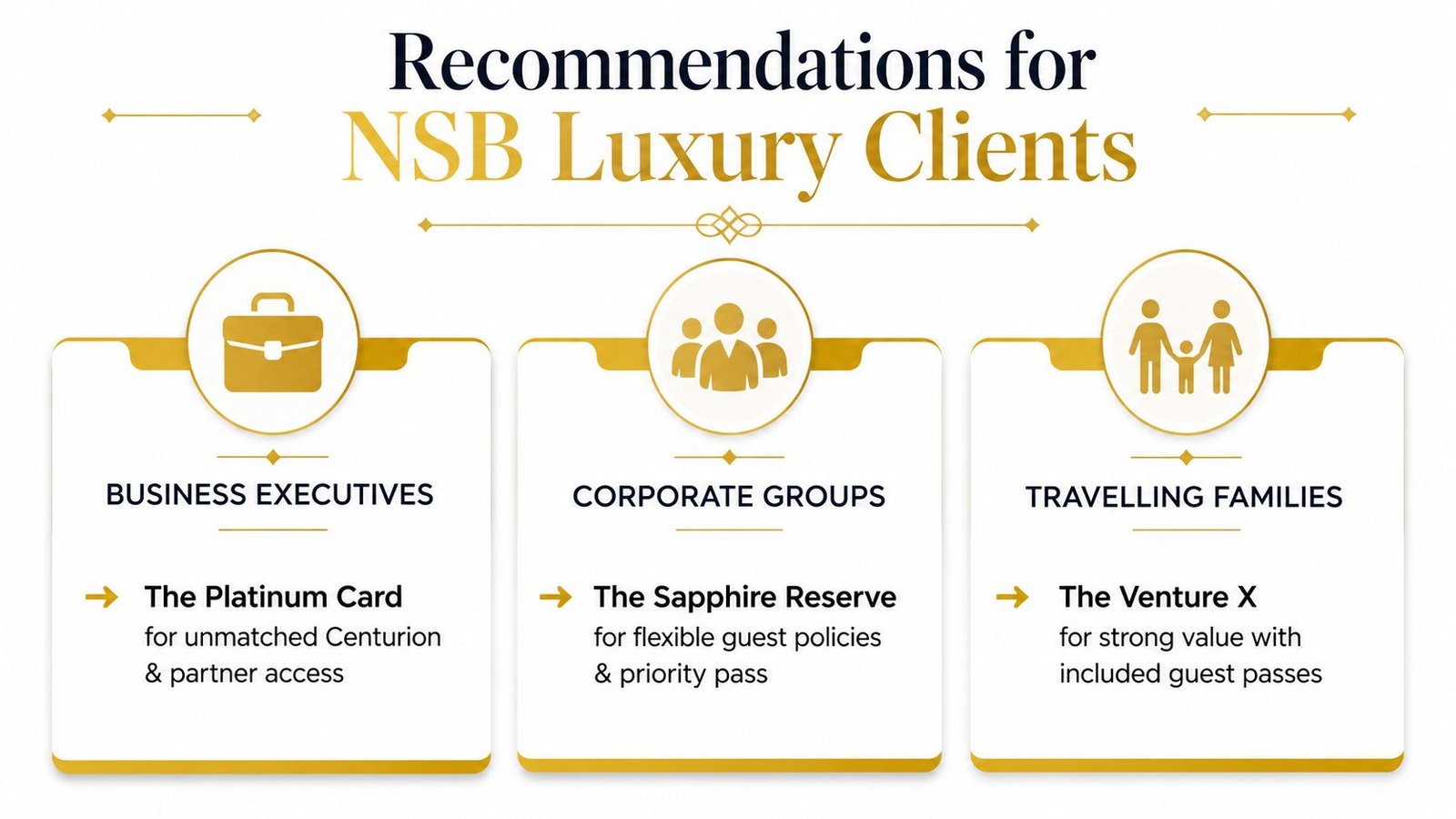
The practical choice by traveller type
- Business executives: Prioritise the broadest network, then check the fee.
- Corporate groups: Prioritise guest rules and authorised-user structure.
- Travelling families: Prioritise the lowest per-trip cost for the whole party.
Luxury car rental Dubai airport
Frequently Asked Questions on Lounge Cards
Can UAE residents use these lounge cards on GCC trips?
Yes, if the card's lounge network matches the airport and the flight rules. The issue isn't residency, it's whether the lounge accepts the card and whether your ticket type qualifies. For UAE residents travelling through Dubai, Abu Dhabi, Oman, or Saudi Arabia, broad network coverage usually matters more than the home country of the cardholder.
Is it worth holding two lounge cards at once?
It can be, if the cards solve different problems. One may give you broader network coverage, while another may offer better guest value. The decision only works if you use both enough to justify the combined annual fees and any guest-related costs.
Does lounge access help on cross-border routes to Oman or Saudi Arabia?
It can, but only when the airport and lounge network align with your itinerary. Cross-border journeys often involve different terminals, carriers, and partner rules, so a broad-access card is more practical than a card tied tightly to one airline. For frequent GCC travellers, route fit matters more than brand loyalty.
If you want a smoother airport-to-city experience to match the lounge strategy you choose, book with NSB Luxury Transport. Our team handles chauffeur service in Dubai, airport transfers, and cross-border travel with the same focus on reliability and comfort that frequent travellers expect from a premium journey.
Book Your Chauffeur Service
Fast booking support for airport transfers, chauffeur service, and private car with driver in Dubai.
WhatsApp: +971 525 579 638
Email: booking@nsbluxurytransport.com
Website: www.nsbluxurytransport.com